Common Mistakes
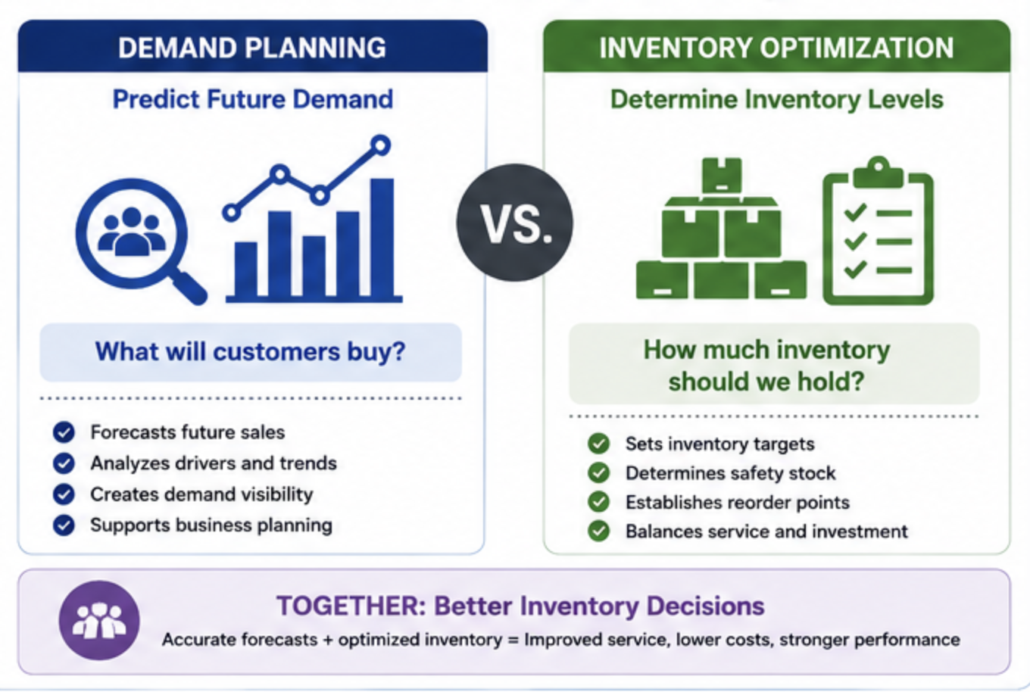
Organizations often view demand planning and inventory optimization as separate initiatives. In reality, the two disciplines are closely connected and deliver the greatest value when used together.
Some of the most common mistakes include:
Focusing Only on Forecasting
Many organizations invest significant effort in improving forecasts but spend less time evaluating how those forecasts translate into inventory decisions.
An organization may achieve substantial improvements in forecast accuracy and still struggle with excess inventory, stockouts, or inconsistent service levels if inventory policies are not aligned with demand expectations.
Forecasts provide visibility into future demand, but they do not automatically determine how inventory should be managed.
Focusing Only on Inventory Reduction
Reducing inventory can improve working capital performance, but aggressive inventory reduction strategies can create unintended consequences if future demand is not fully understood.
Organizations that focus exclusively on lowering inventory levels may experience increased stockouts, missed sales opportunities, expedited shipments, and declining customer service performance.
Inventory decisions should be driven by demand requirements, not inventory reduction targets alone.
Treating Them as Separate Processes
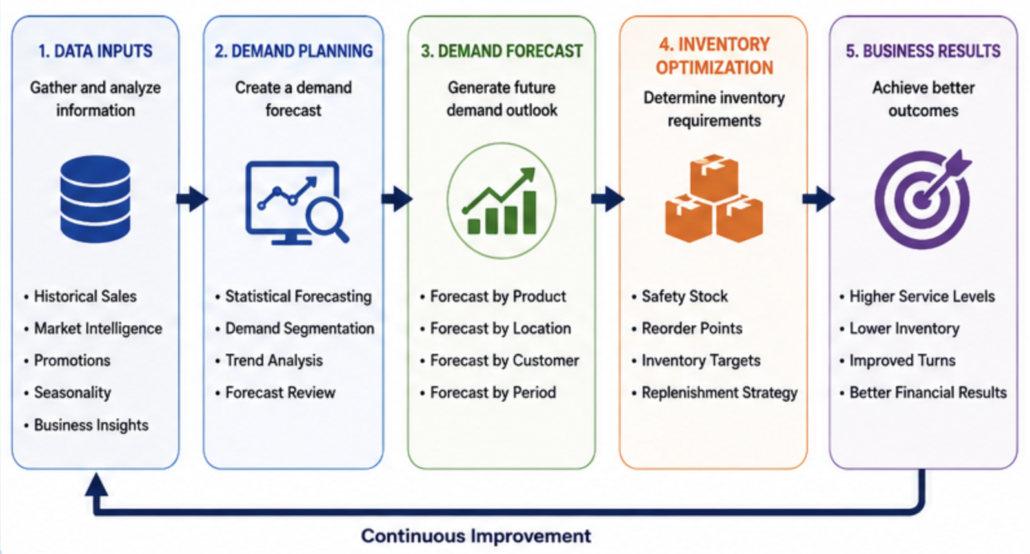
Demand planning and inventory optimization are most effective when they operate as part of a connected planning process.
Demand forecasts provide the foundation for inventory decisions, while inventory optimization helps translate demand expectations into actionable inventory policies.
When these processes operate independently, organizations often miss opportunities to improve both service levels and inventory performance.
The strongest planning organizations view demand planning and inventory optimization as complementary capabilities that work together to support better business outcomes.
Which Is More Important?
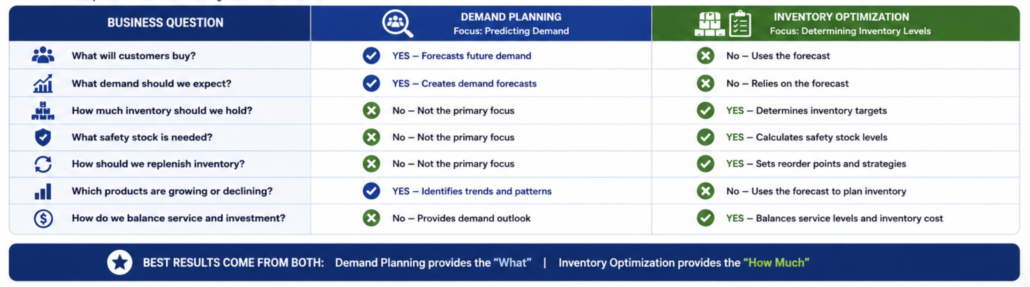
Neither demand planning nor inventory optimization is inherently more important.
They solve different problems, answer different questions, and support different business decisions.
Demand planning focuses on understanding future demand.
Inventory optimization focuses on determining the inventory required to support that demand.
Attempting to prioritize one over the other is similar to asking whether a map is more important than a vehicle. Both play a critical role, but they serve different purposes.
Organizations that focus exclusively on demand planning may improve forecast visibility while continuing to struggle with inventory performance. Conversely, organizations that focus exclusively on inventory optimization may establish inventory policies based on incomplete or inaccurate demand assumptions.
The greatest business value typically occurs when both disciplines work together.
Organizations that excel at both demand planning and inventory optimization are often better positioned to:
- improve service levels
- reduce excess inventory
- increase inventory turns
- improve working capital performance
- reduce stockout risk
- make more confident planning decisions
The question is not whether one capability is more important than the other.
The question is whether the organization has developed both capabilities sufficiently to support its business objectives.
Which Comes First: Demand Planning or Inventory Optimization?
In most organizations, demand planning comes first.
Inventory optimization relies on an understanding of future demand in order to determine appropriate inventory targets.
If future demand is unknown, inventory decisions become significantly more difficult.
This does not mean demand forecasts must be perfect before inventory optimization can provide value.
In fact, inventory optimization often helps organizations manage forecast uncertainty through inventory policies, safety stock calculations, and service-level strategies.
The two disciplines are complementary rather than competitive.
Demand planning improves visibility into future demand.
Inventory optimization helps organizations prepare for that demand efficiently.
Organizations seeking to improve supply chain performance often achieve the greatest results when both capabilities are used together.
Frequently Asked Questions
Is demand planning the same as inventory optimization?
No. Demand planning forecasts future customer demand, while inventory optimization determines the inventory levels needed to support that demand.
Can you have inventory optimization without demand planning?
Yes, but inventory decisions are generally more effective when they incorporate reliable demand forecasts. Inventory optimization performs best when informed by future demand expectations.
Which is more important: demand planning or inventory optimization?
Neither is inherently more important. Demand planning helps organizations understand future demand, while inventory optimization helps determine how much inventory is needed to support that demand. Most organizations benefit from both.
Does inventory optimization improve forecast accuracy?
No. Inventory optimization does not improve forecast accuracy directly. Its purpose is to establish inventory policies and targets that support forecasted demand while balancing service levels and inventory investment.
Why do organizations use both demand planning and inventory optimization?
Using both capabilities helps organizations improve service levels, reduce excess inventory, lower stockout risk, and better align inventory investments with future demand expectations.
Final Thoughts
Demand planning and inventory optimization are closely related, but they solve different business problems.
Demand planning focuses on understanding future customer demand. Inventory optimization focuses on determining the inventory required to support that demand while balancing service levels, inventory investment, and operational risk.
Organizations sometimes view the two disciplines as competing priorities, but the strongest planning organizations recognize that they are complementary capabilities. A forecast alone does not determine how much inventory should be carried, and inventory policies are only as effective as the demand assumptions behind them.
As supply chains become more complex, businesses often discover that improving forecasting without improving inventory decisions leaves value on the table. Likewise, optimizing inventory without understanding future demand can limit the effectiveness of replenishment strategies.
The most successful organizations use demand planning and inventory optimization together to create a more complete planning process. Demand planning provides visibility into what is likely to happen. Inventory optimization helps determine how the business should prepare for it.
The result is better service levels, lower inventory risk, improved working capital utilization, and greater confidence in planning decisions.
The question is not whether demand planning or inventory optimization is more important.
The question is how effectively they work together to support your business goals.