When Open to Buy Works Best
Open to Buy is most valuable when organizations need greater control over inventory investment and purchasing decisions.
Rather than focusing on day-to-day replenishment activity, Open to Buy helps planners manage inventory as a financial asset by balancing inventory levels, purchasing plans, and working capital objectives.
Open to Buy is particularly useful in the following situations:
High Inventory Carrying Costs
Organizations carrying significant inventory often face substantial costs related to storage, handling, obsolescence, insurance, and working capital. Open to Buy helps ensure inventory purchases remain aligned with inventory objectives and prevents unnecessary inventory accumulation.
Cash Flow Constraints
When working capital is limited, inventory investments must be carefully managed. Open to Buy provides visibility into future inventory commitments and helps organizations prioritize purchases that deliver the greatest business value.
Seasonal Inventory Planning
Many organizations make large inventory investments before seasonal demand periods. Open to Buy helps planners evaluate how much inventory can be purchased in advance while remaining within inventory investment targets.
Multi-Category Inventory Management
Retailers, distributors, and manufacturers often allocate inventory budgets across multiple product categories, locations, or business units. Open to Buy provides a structured framework for balancing inventory investment across competing priorities.
Organizations that need stronger financial discipline around inventory investment often benefit significantly from Open to Buy planning.
When Reorder Point Planning Works Best
Reorder Point Planning is most effective when inventory availability and replenishment execution are primary planning concerns.
Because reorder points provide a structured method for determining when inventory should be replenished, they are particularly useful in environments where inventory levels must be monitored continuously and replenishment decisions occur frequently.
Reorder Point Planning is especially valuable in the following situations:
High-Volume SKUs
Products with frequent demand and regular replenishment cycles often benefit from reorder point planning because inventory positions can be monitored and replenished consistently without requiring extensive manual intervention.
Stable Demand Patterns
Products with relatively predictable demand are often well suited for reorder point methodologies. Consistent demand patterns make it easier to establish replenishment parameters that maintain inventory availability while minimizing excess inventory.
Service-Level Management
Organizations focused on reducing stockouts and improving customer service frequently use reorder point planning to ensure inventory is replenished before shortages occur.
Operational Efficiency
Many organizations use reorder points to automate replenishment decisions and reduce manual planning effort. Well-maintained reorder point parameters can help planners focus on exceptions rather than routine inventory decisions.
When the primary objective is maintaining inventory availability while improving replenishment efficiency, Reorder Point Planning often provides significant value.
Can You Use Both?
Absolutely.
In fact, many organizations achieve the best results when Open to Buy and Reorder Point Planning are used together rather than independently.
The two approaches address different aspects of inventory management and can complement each other effectively.
Strategic Level
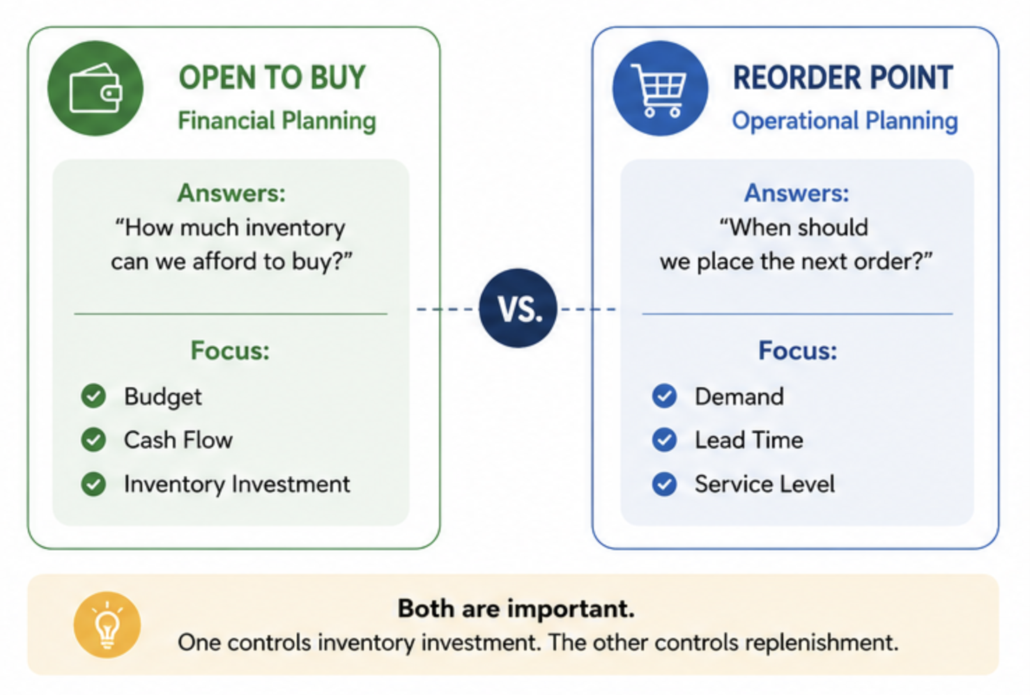
Open to Buy helps establish inventory investment guardrails. It provides visibility into inventory budgets, inventory targets, and working capital requirements, helping ensure purchasing decisions remain aligned with financial objectives.
Tactical Level
Reorder Point Planning supports day-to-day replenishment execution. It determines when inventory should be reordered based on inventory levels, demand expectations, and replenishment requirements.
Together, these approaches allow organizations to:
- control inventory spending
- maintain service levels
- reduce excess inventory
- improve inventory turns
- improve working capital performance
- support more disciplined purchasing decisions
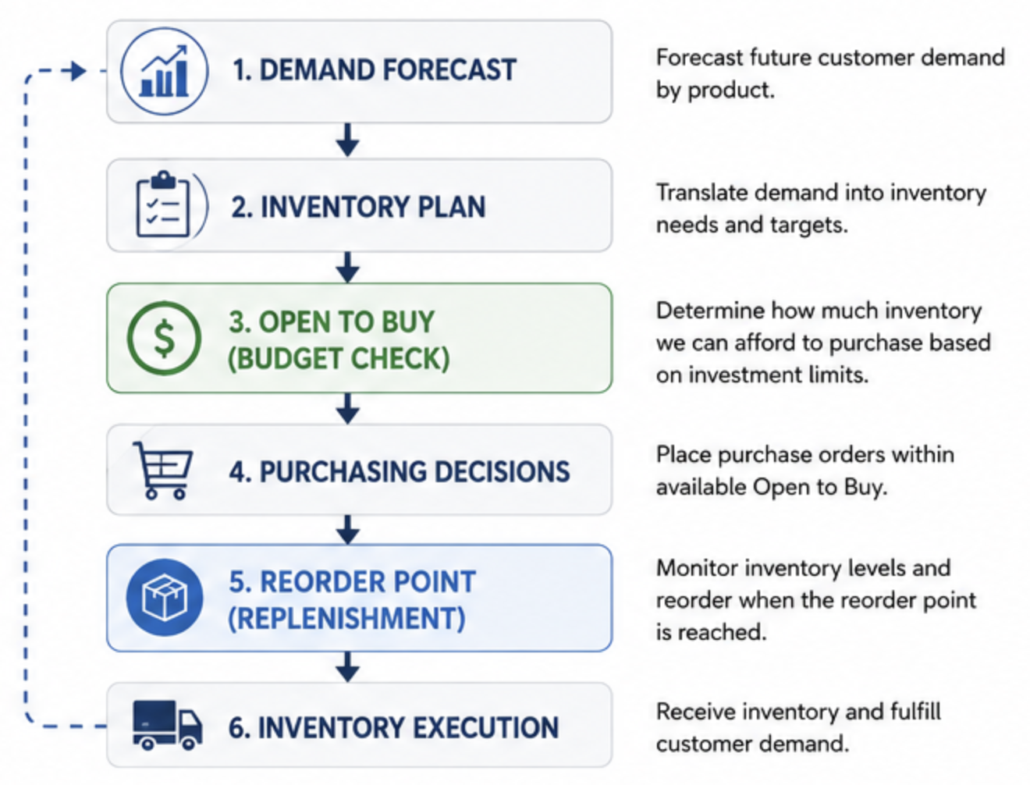
Rather than choosing one approach over the other, many organizations use Open to Buy to establish inventory investment limits and Reorder Point Planning to manage replenishment activity within those limits.
This creates a more balanced inventory management strategy that supports both financial and operational objectives.
Common Mistakes
Organizations often encounter challenges when Open to Buy and Reorder Point Planning are implemented without a clear understanding of their respective roles.
Some of the most common mistakes include:
Using Only Open to Buy
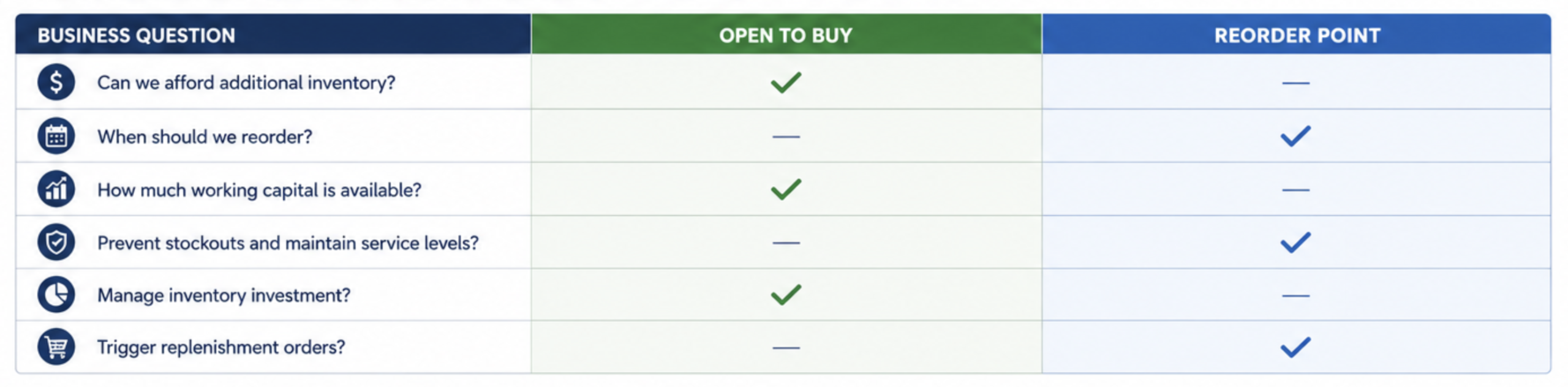
Open to Buy can help organizations control inventory investment, but it does not determine when inventory should be replenished.
Organizations that rely exclusively on Open to Buy may successfully manage inventory budgets while still experiencing stockouts, service-level issues, and replenishment problems because inventory availability is not being actively monitored.
Using Only Reorder Points
Reorder Point Planning helps maintain inventory availability, but it does not directly control inventory investment.
Organizations that rely exclusively on reorder points may maintain strong service levels while gradually accumulating excess inventory and increasing working capital requirements.
Ignoring Demand Variability
Both Open to Buy and Reorder Point Planning depend on reasonable demand assumptions.
When demand patterns change significantly, inventory budgets and replenishment parameters may no longer reflect current business conditions. Failing to account for demand variability can reduce the effectiveness of both approaches.
Treating Parameters as Static
Inventory policies should evolve as business conditions change.
Organizations that establish Open to Buy budgets or reorder point parameters and then fail to review them regularly may find that inventory performance gradually deteriorates over time.
The most effective inventory planning organizations continuously evaluate both inventory investment strategies and replenishment policies to ensure they remain aligned with business objectives.