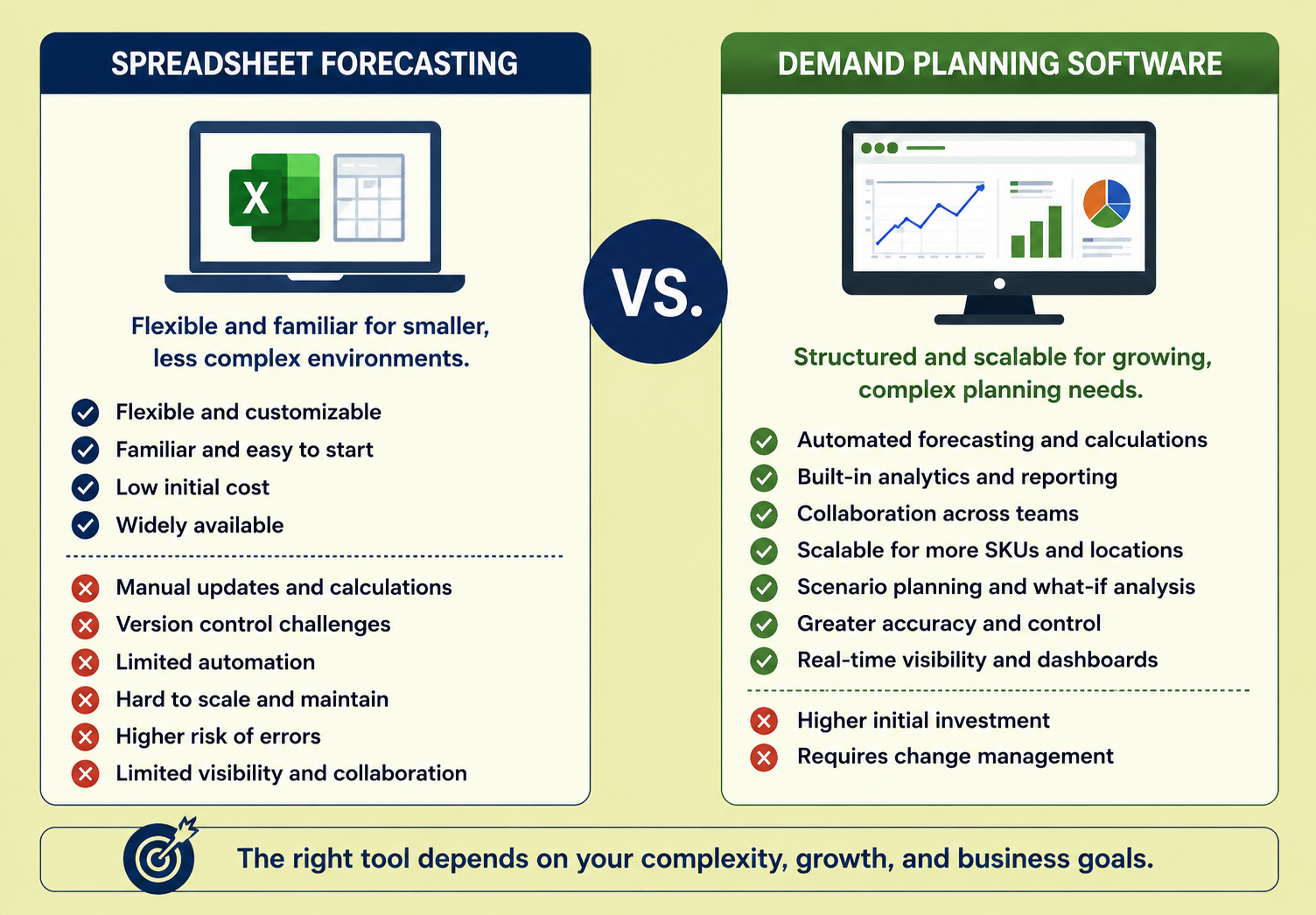
Spreadsheet Forecasting vs Demand Planning Software
Spreadsheets are not inherently bad. In fact, they are often the right solution early in an organization’s planning journey. They give planners flexibility, control, and speed without requiring a formal software implementation.
Flexibility
Spreadsheets allow users to create customized calculations, reports, and planning models quickly. A planner can adjust formulas, add assumptions, create custom views, and test different approaches without waiting for development resources. This flexibility can be especially useful when planning processes are still evolving.
Low Cost
Most organizations already have access to spreadsheet tools, which makes the initial cost extremely low. For smaller planning teams, this can be appealing because they can begin forecasting without adding another system or budget line item.
Familiarity
Excel and Google Sheets are familiar to most business users. Planners, finance teams, sales teams, and executives often understand how to review and manipulate spreadsheet data. This familiarity reduces training requirements and can make adoption easier in the early stages.
Rapid Deployment
New models can be built quickly in spreadsheets. When a business needs a simple forecast, inventory report, or planning template, spreadsheets allow teams to move fast. However, rapid deployment can become a weakness when models are not governed, documented, or maintained consistently.
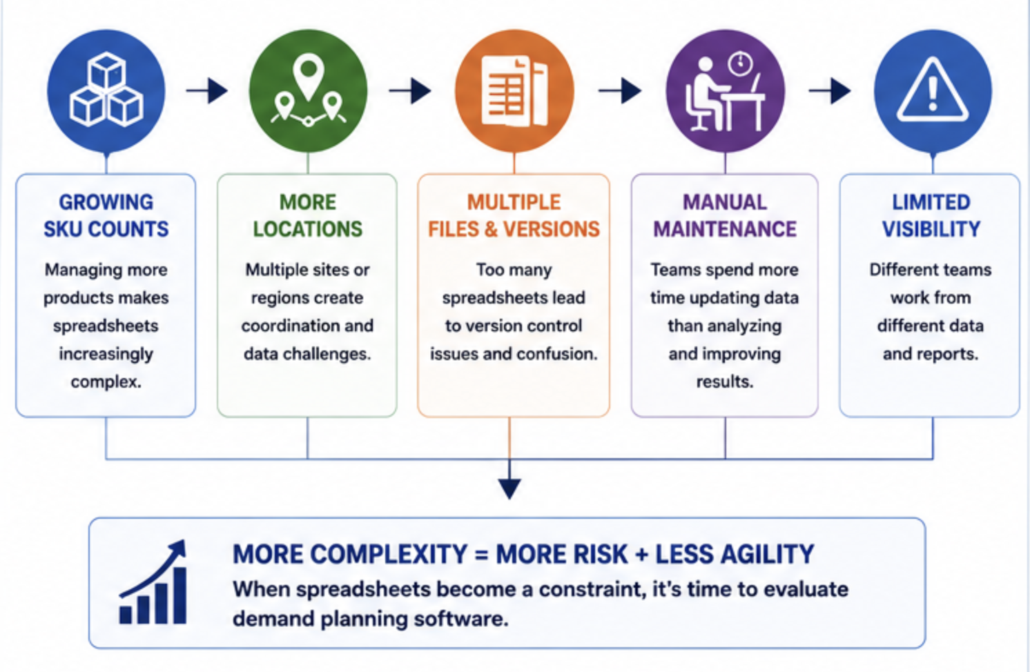
When Spreadsheets Become a Problem
As planning complexity increases, spreadsheet limitations become more apparent. What worked for a smaller business may become difficult to maintain as product portfolios expand, locations increase, and more teams become involved in planning.
Growing SKU Counts
Managing hundreds or thousands of products manually becomes increasingly difficult. Each additional SKU creates more demand history, more forecast assumptions, and more replenishment decisions. As SKU counts grow, spreadsheet-based planning often becomes slower, more error-prone, and harder to scale.
Multiple Locations
Planning across multiple warehouses, stores, regions, or distribution centers adds another layer of complexity. Demand patterns may vary by location, inventory availability may differ across the network, and planners may need to coordinate replenishment decisions across multiple teams. Spreadsheets can struggle to provide a consistent view of demand and inventory across locations.
Manual Data Maintenance
Many planning teams spend significant time exporting data, copying information between files, updating formulas, refreshing reports, and checking for errors. This manual effort reduces the time available for analysis and decision-making. When planners spend more time maintaining spreadsheets than interpreting demand, the process has likely become too manual.
Lack of Visibility
Different departments often operate from different versions of the truth. Sales may have one forecast, finance may have another, and supply chain may be working from a separate planning file. This lack of visibility can create confusion, slow decisions, and make it difficult to align around a single plan.
Increased Risk of Errors
Spreadsheet forecasting depends heavily on formulas, manual updates, and user discipline. A broken formula, incorrect copy-and-paste action, outdated file, or hidden assumption can distort the plan. As spreadsheets become larger and more complex, the risk of errors increases significantly.
Benefits of Demand Planning Software
Organizations often move beyond spreadsheets when they need stronger visibility, better scalability, and more reliable planning processes. Demand planning software provides structure around forecasting and inventory planning so teams can make better decisions with less manual effort.
Improved Forecast Accuracy
Advanced forecasting methods can improve demand visibility by analyzing historical trends, seasonality, demand patterns, and exceptions more consistently than manual spreadsheet models. While software alone does not guarantee perfect forecasts, it can provide a stronger foundation for measuring and improving forecast performance.
Better Collaboration
Demand planning is rarely owned by one department. Sales, operations, finance, supply chain, purchasing, and leadership all influence planning outcomes. Demand planning software helps teams work from a common plan, reducing version-control issues and improving alignment across the business.
Increased Efficiency
Automation reduces the manual effort required to update data, refresh reports, calculate forecasts, and maintain planning files. This allows planners to spend more time on analysis, exception management, scenario planning, and decision-making instead of spreadsheet maintenance.
Greater Visibility
Real-time reporting and dashboards give planners and leaders a clearer view of demand, inventory, forecast performance, and planning risks. Better visibility helps organizations identify issues earlier and respond before they become costly operational problems.
Better Scalability
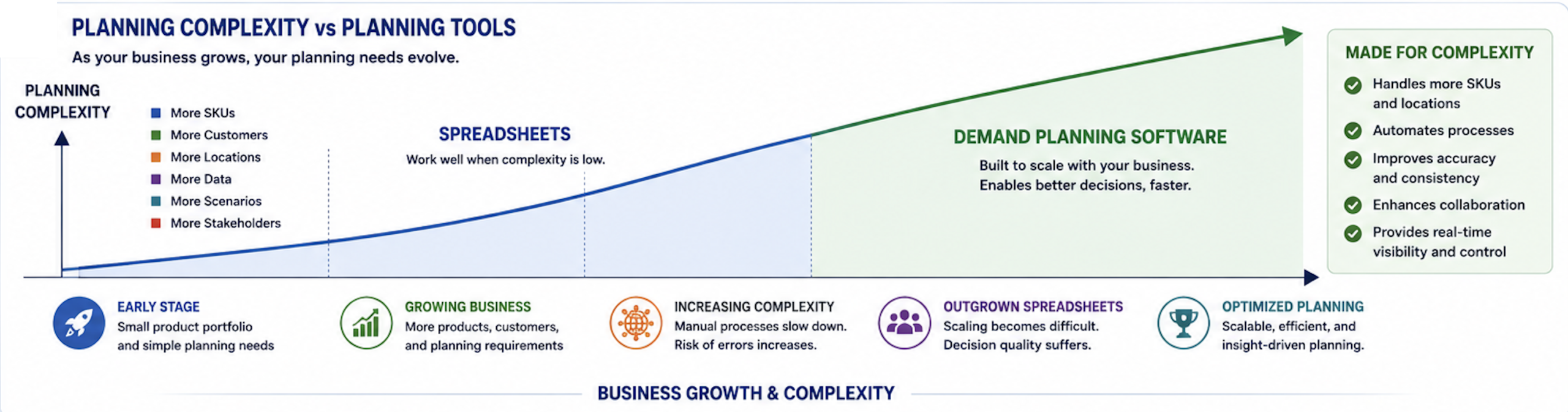
As businesses grow, planning processes must support more products, more customers, more locations, and more complexity. Demand planning software provides a more scalable foundation than disconnected spreadsheets, allowing planning capabilities to grow with the business.
How to Know When It’s Time to Move Beyond Excel
Organizations should consider evaluating demand planning software when spreadsheets begin limiting visibility, efficiency, accuracy, or decision-making. The decision is not based on company size alone. It is based on planning complexity.
Common signs include:
Spreadsheets Dominate Planning Activities
If most planning work happens through manually maintained spreadsheets, the organization may be carrying unnecessary process risk. When key decisions depend on individual files, hidden formulas, and manual updates, planning becomes harder to govern and scale.
Forecast Accuracy Is Difficult to Measure
If teams cannot easily measure forecast accuracy or understand why forecasts are improving or declining, it becomes difficult to improve planning performance. Demand planning software can help track forecasting metrics more consistently and make performance trends easier to identify.
Inventory Investment Continues Growing
Rising inventory levels may indicate that planning processes are not keeping pace with demand complexity. When teams lack confidence in the forecast, they may compensate by carrying excess inventory, increasing working capital pressure.
Planning Cycles Consume Excessive Time
If monthly or weekly planning cycles require extensive manual data preparation, spreadsheet consolidation, and report building, the process may be inefficient. Planning software can reduce repetitive work and shorten planning cycles.
Planners Spend More Time Maintaining Data Than Analyzing Results
This is one of the clearest signs that a spreadsheet-based process has reached its limit. Planners should be focused on demand insights, risks, exceptions, and decisions—not simply keeping files updated.
Frequently Asked Questions
Is Excel good for demand forecasting?
Yes. Excel can be a useful demand forecasting tool, especially for smaller organizations or less complex planning environments. It is flexible, familiar, and easy to customize. However, Excel becomes more difficult to manage as SKU counts, locations, users, and planning scenarios increase. The issue is not whether Excel can forecast demand, but whether it can support the level of visibility, control, collaboration, and scalability the organization now needs.
Why do companies move from spreadsheets to demand planning software?
Companies often move beyond spreadsheets when planning becomes too complex to manage manually. Common triggers include growing SKU counts, multiple locations, version-control issues, limited visibility, difficulty measuring forecast accuracy, and excessive time spent maintaining planning files. Demand planning software provides a more structured and scalable way to manage forecasting, inventory planning, collaboration, and reporting.
Does demand planning software replace spreadsheets?
Not entirely. Many organizations continue using spreadsheets for supplemental analysis, ad hoc reporting, and one-off modeling. The difference is that spreadsheets no longer serve as the primary planning system. Demand planning software becomes the central platform for core forecasting and planning processes, while spreadsheets remain useful for supporting analysis.
When should a company consider demand planning software?
A company should consider demand planning software when planning complexity begins affecting business performance. Signs include longer planning cycles, growing inventory investment, inconsistent forecasts, frequent spreadsheet errors, limited cross-functional alignment, or difficulty understanding future demand. The stronger the connection between planning problems and business impact, the more important it becomes to evaluate a dedicated planning solution.
Is demand planning software worth the investment?
For many growing organizations, demand planning software can be worth the investment because it improves visibility, planning efficiency, forecast performance, and inventory decision-making. The value depends on the organization’s complexity, current planning challenges, inventory investment, and ability to adopt stronger planning processes. The strongest business case focuses on outcomes such as reduced manual effort, better inventory performance, improved service levels, and stronger decision-making.
Final Thoughts
Spreadsheets remain a valuable planning tool. They are flexible, familiar, and often highly effective in the early stages of a company’s planning journey.
However, there comes a point where planning complexity begins to exceed what spreadsheets can reasonably support. As organizations add products, locations, customers, suppliers, and planning stakeholders, spreadsheet-based forecasting can become harder to maintain, harder to trust, and harder to scale.
The decision is not about replacing Excel for every use case. It is about determining whether spreadsheets should continue serving as the foundation for core forecasting and inventory planning decisions.
For organizations experiencing increasing complexity, demand planning software can provide the visibility, structure, collaboration, and scalability needed to improve planning performance. It helps teams move beyond manual data maintenance and focus on the work that matters most: understanding demand, managing inventory, reducing risk, and making better business decisions.
The goal is not simply to use better software.
The goal is to build a stronger planning process that can support continued growth.