How Inventory Reduction Impacts ROI
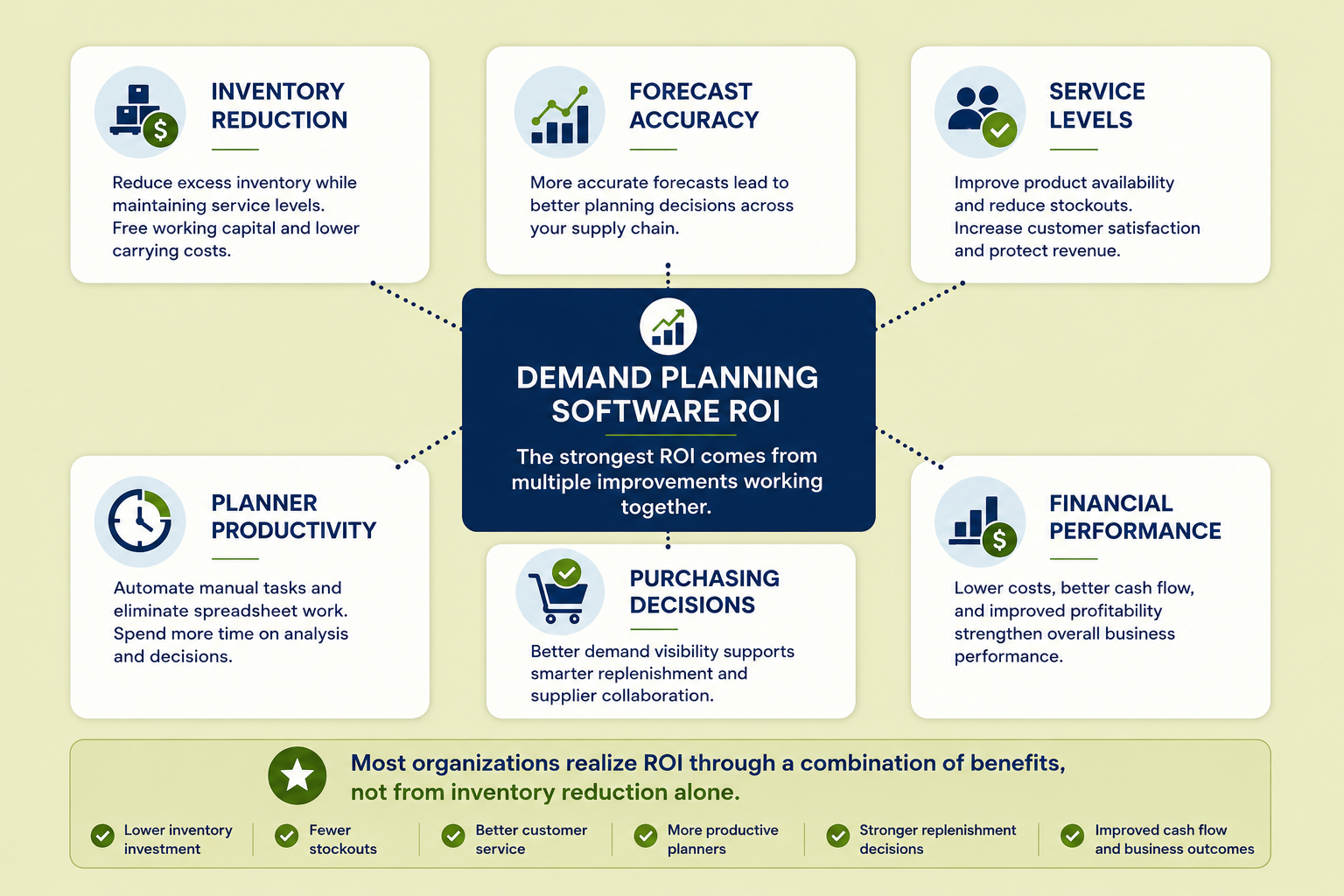
Inventory is often one of the largest assets on the balance sheet. Even modest inventory reductions can create meaningful financial benefits.
For example:
| Current Inventory |
Reduction |
Cash Released |
| $5,000,000 |
10% |
$500,000 |
| $10,000,000 |
10% |
$1,000,000 |
| $20,000,000 |
10% |
$2,000,000 |
Inventory improvements frequently become one of the largest contributors to ROI.
How Forecast Accuracy Impacts ROI
Forecast accuracy influences nearly every planning decision made within an organization. Inventory levels, purchasing decisions, production schedules, supplier commitments, and customer service performance all rely on an understanding of future demand.
When forecasts are inaccurate, organizations often compensate by carrying additional inventory, expediting orders, adjusting production schedules, or accepting higher levels of stockout risk. These actions increase costs and make it more difficult to operate efficiently.
Improved forecasting helps organizations make better decisions by providing a more reliable view of future demand. As forecast quality improves, organizations often experience benefits such as:
- reduced excess inventory
- improved service levels
- reduced expediting costs
- improved production scheduling
- improved purchasing performance
The financial impact of these improvements can be significant. Even modest increases in forecast accuracy may create value across multiple areas of the business, making forecasting performance one of the most important drivers of demand planning software ROI.
How Productivity Improvements Impact ROI
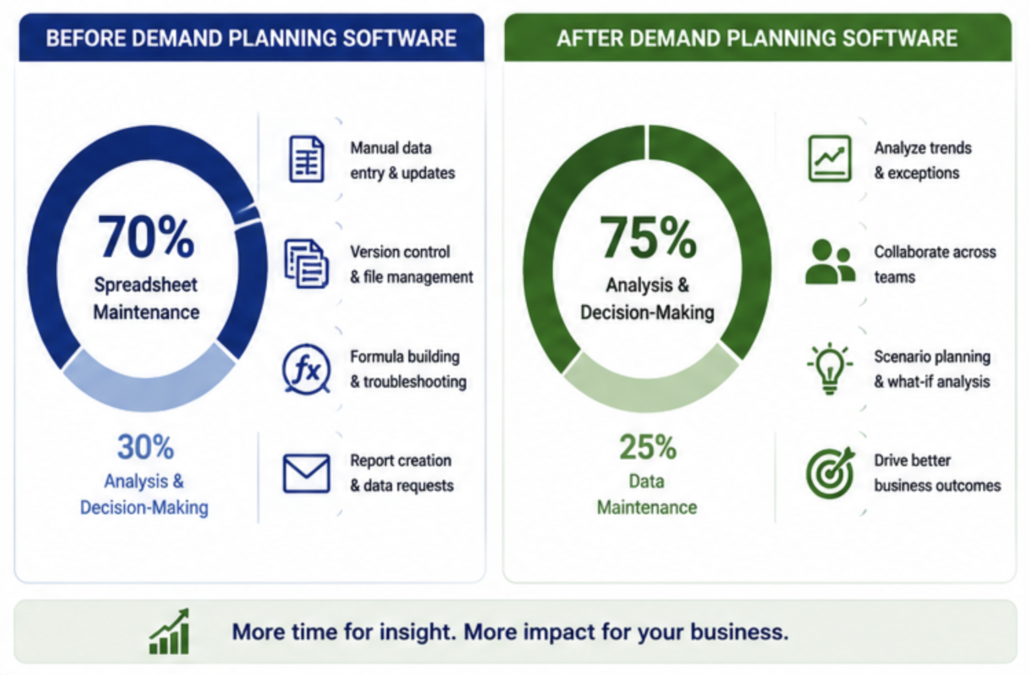
Many planning teams spend a substantial portion of their time collecting data, updating spreadsheets, consolidating information from multiple systems, preparing reports, and resolving version-control issues.
While these activities are necessary, they contribute little direct business value. Every hour spent maintaining spreadsheets is an hour that cannot be spent analyzing demand patterns, evaluating inventory risks, collaborating with stakeholders, or making better planning decisions.
Demand planning software often automates many of these manual processes by centralizing data, standardizing workflows, and reducing reliance on disconnected spreadsheets.
As a result, planners can shift their focus from data maintenance to higher-value activities such as:
- demand analysis
- exception management
- inventory optimization
- scenario planning
- cross-functional collaboration
These productivity improvements allow organizations to manage greater planning complexity without requiring proportional increases in staffing. Over time, the resulting efficiency gains can become a meaningful contributor to overall ROI.
Building a Business Case
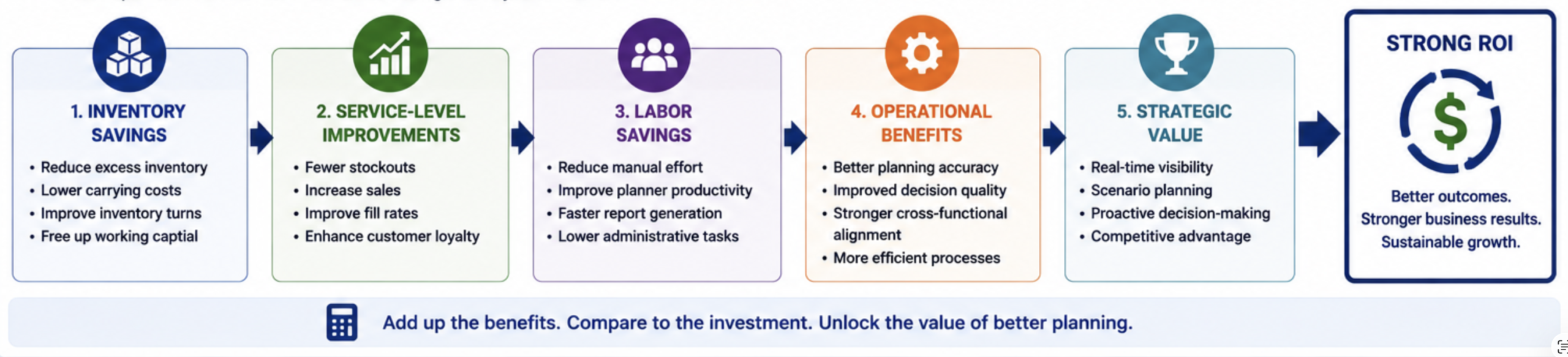
Calculating ROI is only one part of evaluating demand planning software. Decision-makers also need to understand how planning improvements translate into broader business outcomes. A strong business case connects operational improvements to measurable financial and strategic benefits.
While every organization is different, most business cases evaluate the following areas when estimating potential return on investment.
Inventory Savings
Inventory reduction is often one of the largest contributors to demand planning software ROI. Improved forecasting and inventory planning can help organizations reduce excess stock while maintaining service levels, freeing working capital that can be invested elsewhere in the business. In addition to releasing cash, lower inventory levels may reduce carrying costs, obsolescence risk, storage expenses, and insurance costs.
Service-Level Improvements
Better planning helps organizations position inventory more effectively, reducing stockouts and improving product availability. Improved service levels can increase customer satisfaction, strengthen customer retention, and reduce lost sales opportunities. For many organizations, the financial impact of improved service performance extends well beyond the supply chain.
Labor Savings
Planning teams often spend significant time collecting data, updating spreadsheets, preparing reports, and resolving version-control issues. Demand planning software can automate many of these activities, allowing planners to spend more time analyzing demand trends and making informed decisions. These productivity improvements can help organizations manage greater complexity without adding headcount.
Operational Improvements
Improved forecasting supports better decision-making across purchasing, production, inventory management, and supply chain operations. Organizations often experience fewer surprises, reduced firefighting, and more efficient planning processes. While these improvements may be difficult to quantify individually, they frequently contribute meaningful value over time.
Strategic Benefits
Some of the most important benefits of improved planning extend beyond immediate financial savings. Better visibility into future demand, stronger collaboration across departments, and improved decision support can help organizations respond more effectively to market changes and pursue growth opportunities with greater confidence. These strategic advantages often become increasingly valuable as businesses scale.
Common ROI Mistakes
Focusing Only on Inventory Reduction
Inventory reduction is often one of the largest contributors to ROI, but it is rarely the only source of value. Organizations that focus exclusively on inventory savings may overlook benefits such as improved service levels, productivity gains, purchasing efficiencies, and stronger financial performance. A comprehensive ROI analysis should evaluate all potential areas of impact rather than relying on a single metric.
Ignoring Productivity Improvements
Many planning teams underestimate the value of labor efficiency. Reducing manual spreadsheet maintenance, report preparation, and data consolidation can free planners to focus on analysis and decision-making. Over time, these productivity gains can become a meaningful source of value, particularly for organizations managing large product portfolios or complex supply chains.
Using Unrealistic Assumptions
Overly optimistic projections can undermine the credibility of a business case. While planning improvements can deliver substantial benefits, ROI estimates should be grounded in realistic assumptions and achievable performance improvements. Conservative estimates are often more persuasive than aggressive projections that may be difficult to validate later.
Looking Only at Software Cost
The goal of an ROI analysis is not simply to minimize software expense. Organizations should evaluate the relationship between investment and business value. A solution with a higher cost may ultimately generate greater returns if it delivers larger inventory reductions, stronger service levels, improved productivity, and better business outcomes.
Frequently Asked Questions
What is a good ROI for demand planning software?
There is no universal benchmark, as ROI depends on inventory levels, planning complexity, organizational maturity, and implementation success. Many organizations target payback periods of 12 to 24 months, though some realize benefits sooner. The most important consideration is whether the expected business improvements justify the investment required to achieve them.
What contributes most to ROI?
Inventory reductions, forecast accuracy improvements, and planner productivity gains are often among the largest contributors to ROI. However, service-level improvements, purchasing efficiencies, and stronger decision-making can also create meaningful value. Most organizations realize ROI through a combination of improvements rather than a single source of savings.
How quickly can ROI be achieved?
Some benefits may be realized within the first few months after implementation, particularly productivity improvements and enhanced visibility. Larger gains related to inventory optimization, forecast accuracy, and process maturity often develop over time as teams adopt new planning processes and refine their forecasting approach.
Does ROI depend on company size?
Yes. Factors such as inventory investment, SKU complexity, supply chain structure, and planning maturity all influence potential ROI. Larger organizations may have more opportunities for inventory reduction, while smaller organizations may realize significant value through improved efficiency and better planning decisions.
Can demand planning software improve cash flow?
Yes. One of the most common financial benefits of improved planning is reduced inventory investment. By carrying inventory more efficiently, organizations can free working capital that would otherwise be tied up in excess stock. Improved cash flow can then be used to support growth initiatives, operational investments, or other strategic priorities.
Final Thoughts
Demand planning software ROI is about much more than generating better forecasts. The greatest value often comes from the cumulative impact of improved planning decisions across inventory management, purchasing, customer service, operations, and financial performance.
While inventory reduction is frequently one of the most visible sources of savings, organizations that achieve the strongest results typically improve multiple areas of the business simultaneously. Better forecast accuracy can support more effective replenishment decisions, improved service levels can reduce lost sales opportunities, and productivity gains can help planners focus on strategic decision-making rather than manual data maintenance.
When evaluating potential ROI, organizations should focus on business outcomes rather than software features. The objective is not simply to implement another tool—it is to improve planning performance, optimize inventory investment, strengthen customer service, and support better business decisions.
The most successful business cases recognize that demand planning software is not merely a technology investment. It is an investment in better planning, better visibility, and ultimately, better business performance.

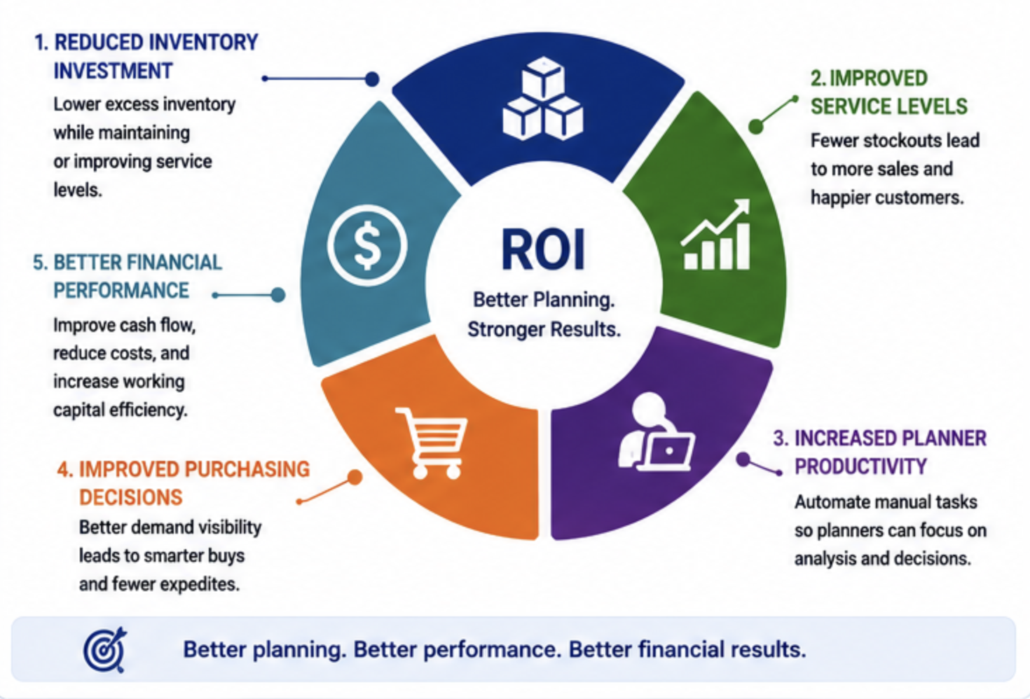 Most organizations do not achieve ROI from a single improvement. Instead, value is usually generated through a combination of inventory reductions, productivity gains, service-level improvements, and better business decisions.