Quick Answer
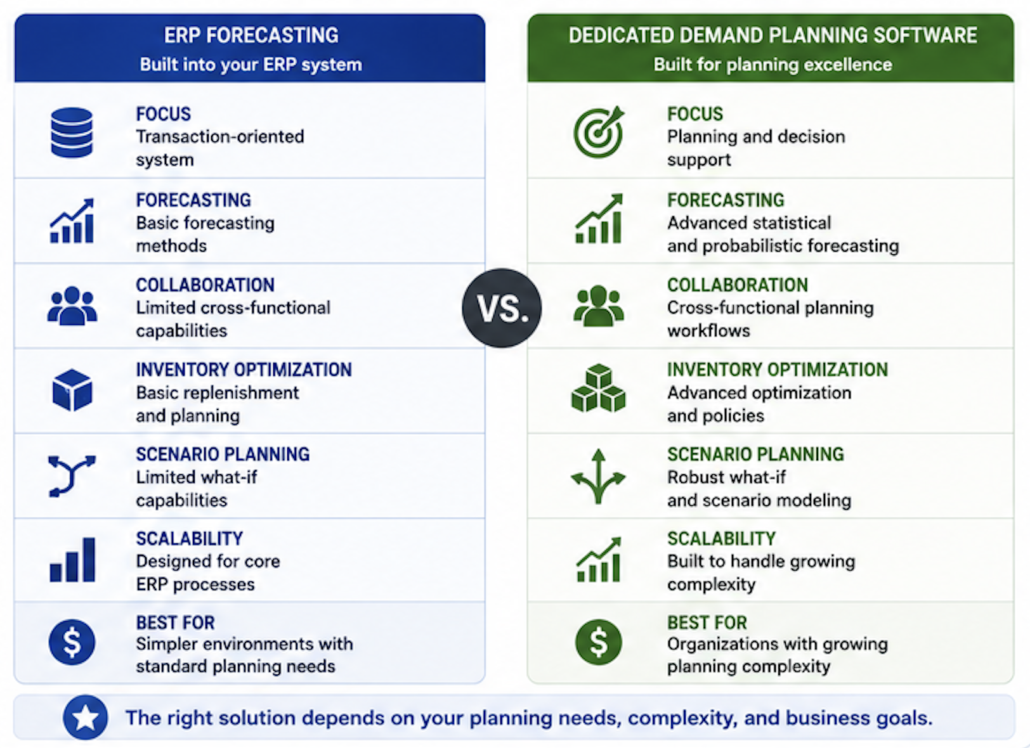
| ERP Forecasting |
Dedicated Demand Planning Software |
| Embedded within ERP |
Specialized planning platform |
| Often focused on transactions |
Focused on planning decisions |
| Typically simpler forecasting |
Advanced forecasting capabilities |
| Limited scenario planning |
Robust what-if analysis |
| Basic collaboration tools |
Cross-functional planning workflows |
| Best for simpler environments |
Best for growing planning complexity |
Both ERP forecasting and dedicated demand planning software can provide value, but they are designed to solve different challenges.
ERP forecasting is often sufficient for organizations with relatively straightforward planning requirements. As forecasting complexity, inventory challenges, and collaboration needs increase, many organizations begin evaluating dedicated planning solutions to support more sophisticated decision-making.
The right choice depends on business requirements, planning maturity, and long-term growth objectives.
What Is ERP Forecasting?
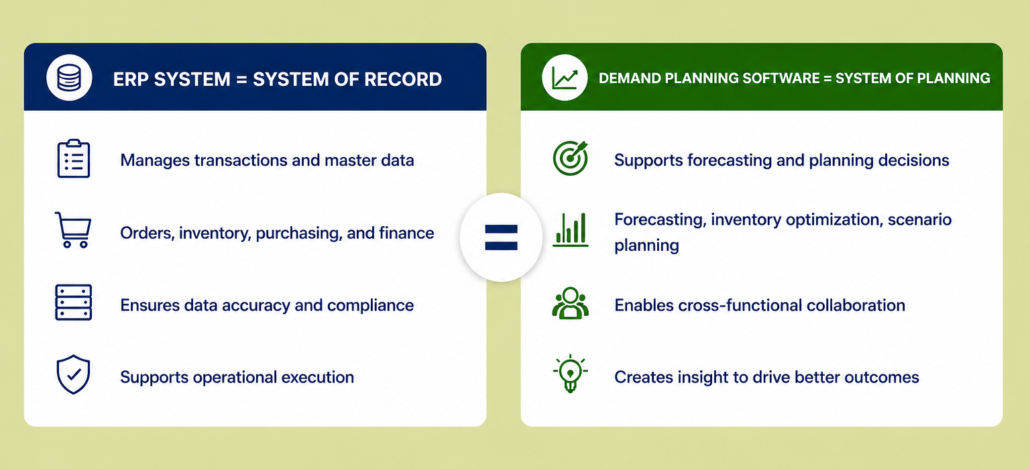
ERP forecasting refers to forecasting and planning functionality that is built directly into an Enterprise Resource Planning (ERP) system. These capabilities are typically designed to help organizations estimate future demand, plan replenishment activities, and support day-to-day operational decision-making.
Many ERP platforms provide functionality such as:
- demand forecasting
- replenishment planning
- inventory planning
- purchasing support
Because forecasting capabilities are embedded within the ERP environment, users can often work with existing transactional data without introducing additional software. Historical sales, inventory balances, purchase orders, and production information are already available within the system, making ERP forecasting an attractive starting point for many organizations.
For companies with relatively simple planning requirements, ERP forecasting may provide sufficient visibility and support. However, as planning complexity grows, organizations often begin evaluating whether more specialized forecasting and planning capabilities are needed.
What Is Dedicated Demand Planning Software?
Dedicated demand planning software is specifically designed to support forecasting, inventory planning, collaboration, and decision-making across the organization. Unlike ERP forecasting tools, which are often one component within a larger transactional system, dedicated planning solutions are built with forecasting and planning as their primary focus.
Rather than focusing primarily on transactions, specialized planning platforms typically provide capabilities such as:
- forecast generation
- forecast accuracy
- forecast bias monitoring
- inventory optimization
- scenario planning
- planning workflows
These capabilities help organizations move beyond simply creating forecasts and toward actively improving planning performance. Many dedicated planning solutions also support collaboration between sales, operations, finance, purchasing, and supply chain teams, helping organizations align around a common view of future demand.
The ultimate goal is not just to generate a forecast, but to improve planning quality, inventory performance, service levels, and business decision-making.
Why Organizations Start with ERP Forecasting
ERP forecasting often provides several advantages, particularly for organizations that are early in their planning maturity journey. Because forecasting capabilities are embedded within the ERP system, they can be a practical starting point for companies looking to improve planning without introducing additional software.
Single System Environment
One of the biggest advantages of ERP forecasting is that users can work within a familiar system. Sales history, inventory balances, purchasing data, production schedules, and customer information already exist within the ERP, reducing the need to switch between multiple applications. For organizations with relatively straightforward planning requirements, having forecasting tools inside the same environment can simplify daily workflows.
Lower Initial Cost
Many ERP systems include forecasting functionality as part of an existing software investment. Rather than purchasing a separate planning solution, organizations can often begin forecasting using capabilities they already own. For companies with limited complexity, this can be a cost-effective way to introduce more structure into the planning process while delaying the need for additional technology investments.
Existing Data Integration
Because the ERP serves as the system of record, historical sales, inventory transactions, purchase orders, and production information are already available. This eliminates many of the integration challenges associated with standalone applications and can accelerate implementation. Having a single source of operational data can also improve confidence in the planning process.
Simpler Administration
Supporting fewer systems may reduce administrative overhead for both business users and IT teams. Security, user management, upgrades, and data governance can often be handled within existing ERP processes. For organizations with lean IT resources, simplicity can be a significant advantage.
Where ERP Forecasting Can Fall Short
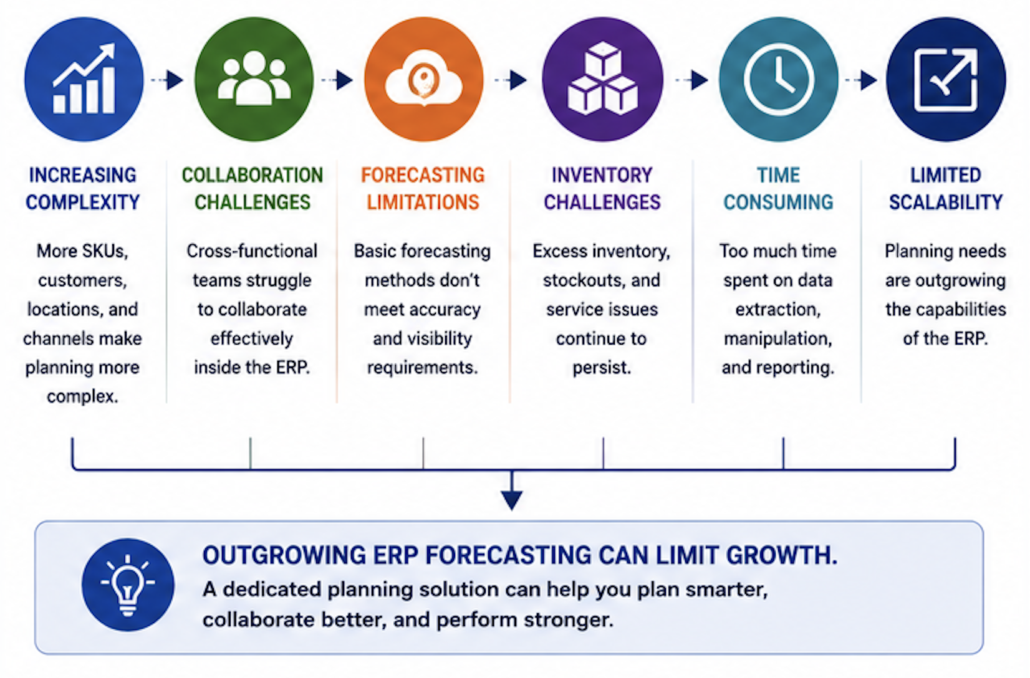
As planning complexity increases, organizations often discover that forecasting capabilities designed primarily for transactional systems may not fully support advanced planning requirements. These limitations do not necessarily mean an ERP system is inadequate—they simply reflect the fact that forecasting is only one of many functions the ERP must perform.
Forecasting Sophistication
Many ERP forecasting tools focus on basic forecasting approaches designed to support operational planning. While these methods may be sufficient for stable demand environments, organizations with seasonal products, volatile markets, large SKU counts, or complex demand patterns often require more advanced forecasting capabilities. Dedicated planning solutions frequently offer broader statistical forecasting options, forecast performance measurement, and exception management tools.
Scenario Planning
Planning leaders increasingly need to answer “what-if” questions. What happens if demand increases by 15%? What if a key customer is lost? What if lead times double? While some ERP systems provide limited scenario planning functionality, dedicated planning platforms are often designed specifically to evaluate multiple scenarios and support more proactive decision-making.
Cross-Functional Collaboration
Effective planning rarely happens within a single department. Sales, operations, finance, purchasing, and supply chain teams all contribute valuable insights. Many ERP forecasting tools focus primarily on operational users, while dedicated planning solutions often include workflows, approvals, collaboration tools, and shared visibility that support a more integrated planning process.
Inventory Optimization
Forecasting is only one part of the planning equation. Organizations must also determine how much inventory to hold, where to position inventory, and how to balance service levels against inventory investment. While some ERP systems offer inventory planning functionality, inventory optimization capabilities vary significantly between platforms and may not provide the depth required by organizations seeking to improve inventory performance.
Scalability
As businesses grow, planning requirements often become more complex. Additional products, locations, customers, suppliers, and planning horizons create new challenges. What works effectively for a few hundred SKUs may become increasingly difficult to manage across thousands of items and multiple facilities. Dedicated planning solutions are often designed with this level of complexity in mind.
When Dedicated Demand Planning Software Makes Sense
Dedicated demand planning software is not necessary for every organization. However, there are several common situations where companies begin evaluating specialized planning solutions to support growth, improve visibility, and strengthen decision-making.
Growing Product Portfolios
As SKU counts increase, forecasting becomes more challenging. Planners must manage a wider range of demand patterns, product lifecycles, and exceptions. What was once manageable through basic forecasting tools can quickly become difficult as product portfolios expand. Dedicated planning software can help organizations scale forecasting processes without requiring a proportional increase in planning effort.
Multiple Locations
Managing inventory and demand across multiple facilities introduces additional complexity. Planners must account for regional demand differences, varying lead times, inventory transfers, and service-level objectives. Organizations with multiple locations often benefit from planning tools that provide a consolidated view of demand and inventory across the network.
Inventory Challenges
Recurring stockouts, excess inventory, and inconsistent service levels are often signs that planning processes need improvement. Dedicated planning software can help organizations better align inventory policies with forecasted demand, supporting more informed replenishment decisions and improved inventory performance.
Forecasting Improvement Initiatives
Many organizations reach a point where leadership wants to improve forecasting performance. Whether the goal is higher forecast accuracy, reduced forecast bias, or better visibility into demand trends, specialized planning tools often provide capabilities specifically designed to support continuous forecasting improvement.
Cross-Functional Planning Requirements
As organizations mature, planning increasingly becomes a collaborative process. Sales, operations, finance, purchasing, and supply chain teams need visibility into the same assumptions and plans. Dedicated planning solutions often provide workflows and collaboration capabilities that help align stakeholders around a common forecast and planning strategy.