Agnostic Demand Planning vs ERP-Embedded Demand Planning: What’s the Difference?

Many manufacturers and distributors start their demand planning journey using forecasting tools built into their ERP system. Over time, as planning becomes more complex and demand becomes more variable across channels, products, and locations, many organizations evaluate whether a dedicated, ERP-agnostic demand planning platform is a better fit.

This guide explains the key differences between agnostic demand planning tools and ERP-embedded planning tools, and when organizations typically move from one to the other.

Many organizations evaluating these approaches also explore tools listed in our Best Demand Planning Software guide.

Who This Guide Is For

This guide is designed for:

  • Companies currently using ERP-based forecasting tools (NetSuite, Acumatica, Dynamics, etc.)
  • Teams experiencing limitations with spreadsheets or ERP planning modules
  • Organizations evaluating whether to invest in a dedicated demand planning platform

Overview: Agnostic vs ERP-Embedded Planning

Category Agnostic Demand Planning ERP-Embedded Planning
Core Purpose Dedicated planning and decision support Transactional support within ERP
Data Scope Multiple systems (ERP, CRM, external data) Primarily ERP data
Flexibility Highly configurable Limited by ERP structure
Analytics Advanced visibility and insights Basic reporting
Scenario Planning Strong what-if capabilities Limited or manual
User Experience Planner-focused ERP-user-focused
Implementation Standalone deployment Built into ERP
Best Fit Strategic planning teams Basic forecasting needs

What Is ERP-Embedded Demand Planning?

ERP-embedded demand planning refers to forecasting and planning tools that are built directly into ERP systems such as NetSuite, Acumatica, or Microsoft Dynamics.

These tools are typically designed to:

  • Generate forecasts based on historical data
  • Support purchasing and replenishment decisions
  • Integrate tightly with transactional workflows

Because they are built into the ERP, they are often the starting point for demand planning.

Many of these tools were originally designed for simpler, single-channel environments and are not well suited to today’s multi-channel, multi-location, and highly variable demand patterns.

What Is Agnostic Demand Planning?

Agnostic demand planning tools are standalone platforms designed specifically for forecasting, planning, and decision-making.

They are called “agnostic” because they:

  • Integrate with multiple systems (ERP, CRM, spreadsheets, external data)
  • Operate independently of any single ERP
  • Provide a unified planning layer across the business

These platforms are typically adopted when planning becomes more complex or more strategically important, particularly in environments with multiple channels, locations, and sources of demand variability.

Key Differences

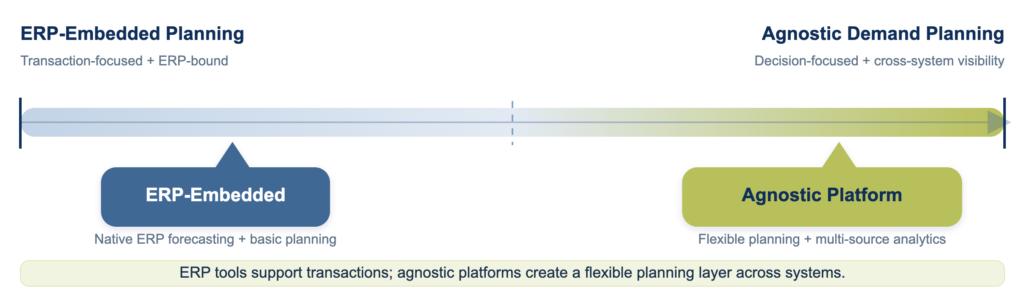
Spectrum comparing ERP-embedded demand planning and agnostic demand planning, showing ERP tools as transaction-focused and agnostic platforms as decision-focused with greater flexibility and visibility.

1. Planning vs Transactional Focus

ERP-embedded tools are designed to support transactions (purchasing, inventory updates, order management).

Agnostic planning platforms are designed to support decisions—helping planners evaluate trade-offs, risks, and opportunities.

This is one of the most fundamental differences between the two approaches.

2. Data Visibility

ERP-based planning tools are limited to data inside the ERP.

Agnostic platforms combine:

  • ERP data
  • Sales data
  • External signals
  • Planner inputs

This creates a more complete view of demand.

3. Flexibility and Workflow

ERP tools are constrained by how the ERP is structured.

Agnostic platforms allow teams to:

  • Adjust workflows
  • Customize planning processes
  • Adapt to real-world operations

This becomes critical as planning complexity increases, especially in today’s more dynamic and multi-market supply chain environments.

4. Scenario Planning and Decision Support

Agnostic platforms provide strong what-if analysis, allowing planners to evaluate different scenarios before making decisions.

ERP tools typically require:

  • Manual analysis
  • Spreadsheets
  • Workarounds

This limits their usefulness for strategic planning.

5. User Experience

ERP planning tools are designed for ERP users, where planning is one of many functions.

Agnostic platforms are designed for planners, with workflows tailored specifically to forecasting and decision-making.

Why Companies Move Beyond ERP-Based Planning

In practice, many organizations follow a similar path as their planning requirements evolve beyond what ERP-based tools were designed to support:

  1. Start with ERP-based forecasting
  2. Improve basic visibility and processes
  3. Encounter limitations as planning becomes more complex
  4. Evaluate dedicated demand planning platforms

Common triggers include:

  • Lack of visibility into demand trends
  • Difficulty running scenarios
  • Limited forecasting flexibility
  • Over-reliance on spreadsheets
  • Growing planning complexity
  • Legacy ERP systems that were not built for today’s complex, multi-market environments

When ERP-Based Planning Is Enough

ERP-based tools can be a good fit when:

  • Forecasting needs are relatively simple
  • Planning is not a strategic priority
  • Teams want to stay entirely within the ERP
  • Minimal change is preferred

When Agnostic Planning Becomes Necessary

Agnostic demand planning platforms are typically a better fit when:

  • Planning becomes more complex or critical
  • Teams need better visibility and analytics
  • Scenario planning is required
  • Multiple data sources need to be combined
  • Planning needs to be more flexible and adaptive

How to Think About the Trade-Off

The decision is not about “better” or “worse”—it’s about fit.

  • ERP-embedded tools prioritize integration and simplicity
  • Agnostic platforms prioritize flexibility, visibility, and decision-making

As organizations grow, many find that planning requirements eventually outgrow what ERP-based tools can support.

Frequently Asked Questions

What is ERP-embedded demand planning?

ERP-embedded demand planning refers to forecasting and planning tools built into ERP systems. These tools are often convenient because they are connected to transactional data, but they may be limited in flexibility and advanced planning functionality.

What is agnostic demand planning software?

Agnostic demand planning software is a standalone planning platform that can integrate with multiple systems, including ERP, CRM, spreadsheets, and external data sources.

When should a company move beyond ERP forecasting?

Companies often move beyond ERP forecasting when they need better visibility, more flexible workflows, scenario planning, or a planning process that combines data from multiple systems.

Is ERP forecasting enough for demand planning?

ERP forecasting may be enough for basic needs, but many organizations outgrow it as demand patterns, channels, products, or planning requirements become more complex.

Why do companies choose agnostic demand planning platforms?

Companies choose agnostic platforms when they need a dedicated planning layer that supports better analytics, cross-system visibility, scenario planning, and planner-driven decision-making.

Why do companies outgrow ERP forecasting tools?

Companies often outgrow ERP forecasting tools as their planning needs become more complex and demand becomes more variable across products, channels, and locations. ERP-based tools are typically limited to internal data, basic forecasting methods, and fixed workflows, and were not designed for today’s more dynamic supply chain environments. As organizations need better visibility, scenario planning, and the ability to combine multiple data sources, they often move to dedicated demand planning platforms.

What makes modern demand planning software different from traditional tools?

Modern demand planning software goes beyond basic forecasting by combining analytics, visibility, and scenario planning into a single platform. Unlike traditional tools or ERP-based systems, modern platforms are designed for planners, integrate multiple data sources, and support more flexible, decision-driven workflows.

Summary

ERP-embedded demand planning tools are a natural starting point for many organizations, offering convenience and tight integration with transactional systems.

Agnostic demand planning platforms provide a more advanced approach, with stronger analytics, flexibility, and planner-focused workflows.

For organizations where demand planning is becoming more strategic, the shift from ERP-based planning to a dedicated, agnostic platform is a common and logical next step.

This shift is especially common as organizations move beyond planning tools that were not designed for today’s more complex, multi-channel supply chain environments.

Learn more about the solutions mid-market companies use to improve forecast accuracy and drive better results.

Practical insights, best practices, and expert perspectives on forecasting and supply chain planning.