Common Causes of Forecast Bias
Sales Optimism
Sales teams may unintentionally create upward forecast bias when they overestimate future demand to support growth targets, protect customer availability, or avoid stockouts. While the intent is often reasonable, consistently inflated sales input can cause planning teams to purchase, produce, or allocate more inventory than demand actually supports.
Executive Pressure
Forecast bias can also occur when leadership teams place strong emphasis on revenue growth, service levels, or inventory reduction targets. Planners may feel pressure—intentionally or unintentionally—to adjust forecasts in a direction that supports those objectives. Over time, these adjustments can create systematic bias even when underlying demand patterns do not support the changes.
Inventory Avoidance
Some organizations develop downward forecast bias because planners are trying to avoid excess inventory, markdowns, or write-offs. While reducing inventory risk is important, consistently forecasting below expected demand can lead to stockouts, lost sales, and customer service issues. The result is a forecast that reflects inventory preferences rather than realistic demand expectations.
Poor Data Quality
Inaccurate sales history, missing demand signals, incorrect lead times, or inconsistent product data can all contribute to forecast bias. When forecasting models are built on flawed information, planners may repeatedly overestimate or underestimate future demand without realizing it. Improving data quality is often one of the fastest ways to reduce persistent forecasting bias.
Product Lifecycle Changes
New product introductions, product replacements, seasonal transitions, and end-of-life items can all introduce forecast bias. Historical demand patterns may no longer be reliable, causing forecasts to consistently miss in one direction. Organizations that actively monitor lifecycle changes and adjust forecasting assumptions accordingly are better positioned to reduce bias during periods of transition.
Signs Your Organization Has Forecast Bias
You may have forecast bias if:
- inventory consistently grows despite stable demand
- stockouts occur despite high forecast accuracy
- forecast errors frequently trend in one direction
- planners repeatedly make similar forecast overrides
- actual demand regularly exceeds or trails forecasts
When these patterns appear repeatedly, the issue may not be isolated forecast error. It may indicate a structural forecasting bias that should be reviewed across data, process, and human overrides.
How to Measure Forecast Bias
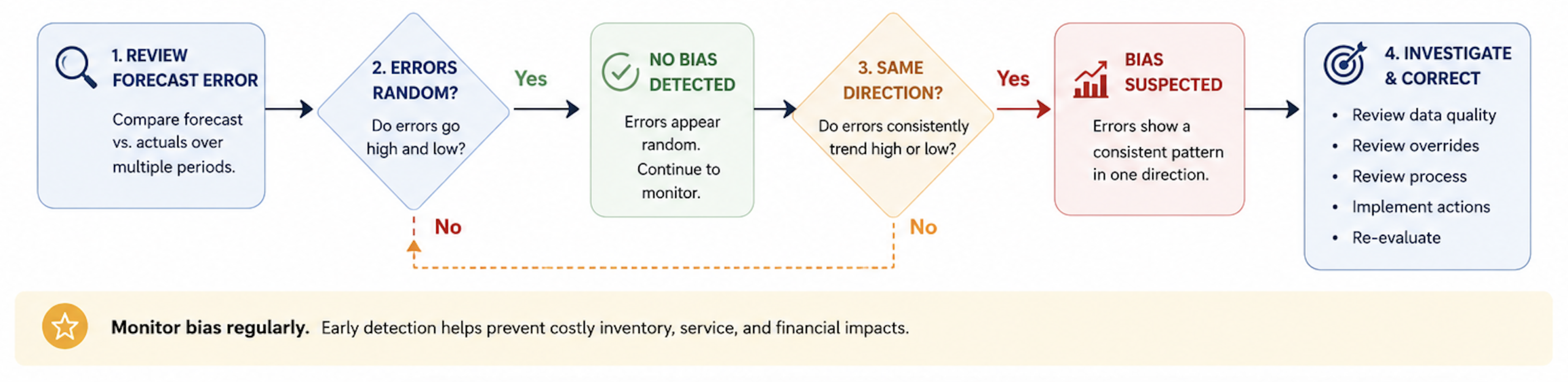
Forecast bias is measured by evaluating whether forecast errors consistently trend in one direction over time.
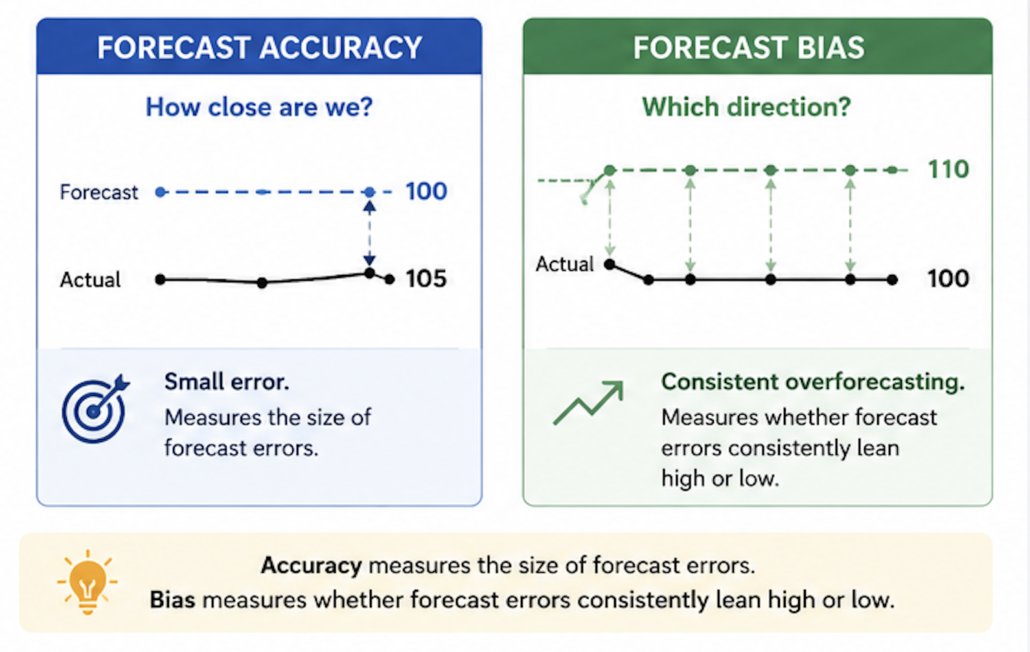
Unlike forecast accuracy, which focuses on the size of forecast errors, forecast bias focuses on the direction of those errors.
The objective is to determine whether forecasts regularly overestimate demand, regularly underestimate demand, or fluctuate around actual demand without a consistent pattern.
Organizations commonly evaluate forecast bias by comparing forecast demand and actual demand across multiple periods and then reviewing cumulative forecast error.
For example:
- Consistently positive forecast error may indicate persistent overforecasting.
- Consistently negative forecast error may indicate persistent underforecasting.
- Errors that fluctuate evenly above and below actual demand may indicate limited bias.
The key is consistency.
A single forecasting miss does not necessarily indicate forecast bias. Demand volatility, unusual events, promotions, supply disruptions, or other factors can create temporary forecasting errors.
Forecast bias becomes a concern when directional forecasting errors occur repeatedly across products, locations, customers, planners, or business units.
Many organizations monitor forecast bias at multiple levels, including:
- individual products
- product families
- planners
- customer groups
- business units
This broader view often helps identify systemic forecasting tendencies that may not be visible when reviewing individual products in isolation.
The goal is not to eliminate every forecasting error.
The goal is to identify and reduce recurring patterns that consistently push forecasts too high or too low.
How to Reduce Forecast Bias
Track Bias Separately from Accuracy
Many organizations focus primarily on forecast accuracy, but accuracy alone does not show whether forecasts are consistently too high or too low. Tracking forecast bias as a separate KPI helps planners identify directional patterns that may be hidden inside broader accuracy metrics.
Reviewing bias by product, category, customer, planner, or business unit can also help reveal where the forecasting process is most likely to be skewed.
Review Forecast Overrides
Forecast overrides are often necessary, but they should be monitored carefully. When planners, sales teams, or executives frequently adjust forecasts in the same direction, bias can gradually become embedded in the forecasting process. Reviewing override history and measuring the impact of adjustments can help organizations distinguish between valuable business insight and systematic bias.
Improve Cross-Functional Alignment
Forecast bias often emerges when different departments operate with competing priorities. Sales teams may prioritize product availability, while finance focuses on inventory investment and operations focuses on service levels. A collaborative forecasting process that incorporates multiple perspectives can help balance these objectives and create more realistic demand plans.
Use Statistical Forecasting as a Baseline
Statistical forecasting provides an objective starting point based on historical demand patterns and measurable trends. While human expertise remains valuable, beginning with a data-driven forecast helps reduce the influence of personal opinions, assumptions, and organizational pressure. Comparing overrides against the statistical forecast can also help identify recurring sources of bias.
Monitor Trends Over Time
Forecast bias should be reviewed on a recurring basis rather than only when major problems occur. Analyzing performance by product family, planner, customer segment, or business unit can reveal patterns that may not be visible at an aggregate level. Regular reviews help organizations identify emerging bias early and make adjustments before inventory or service issues develop.
Forecast Bias Example
Imagine a distributor whose forecasts exceed actual demand by approximately 10% every month.
At first glance, the forecasting process may not appear significantly broken. Forecasts are reasonably close to actual demand, and forecasting performance may appear acceptable when viewed only through high-level accuracy metrics.
However, the directional nature of the errors creates a different problem.
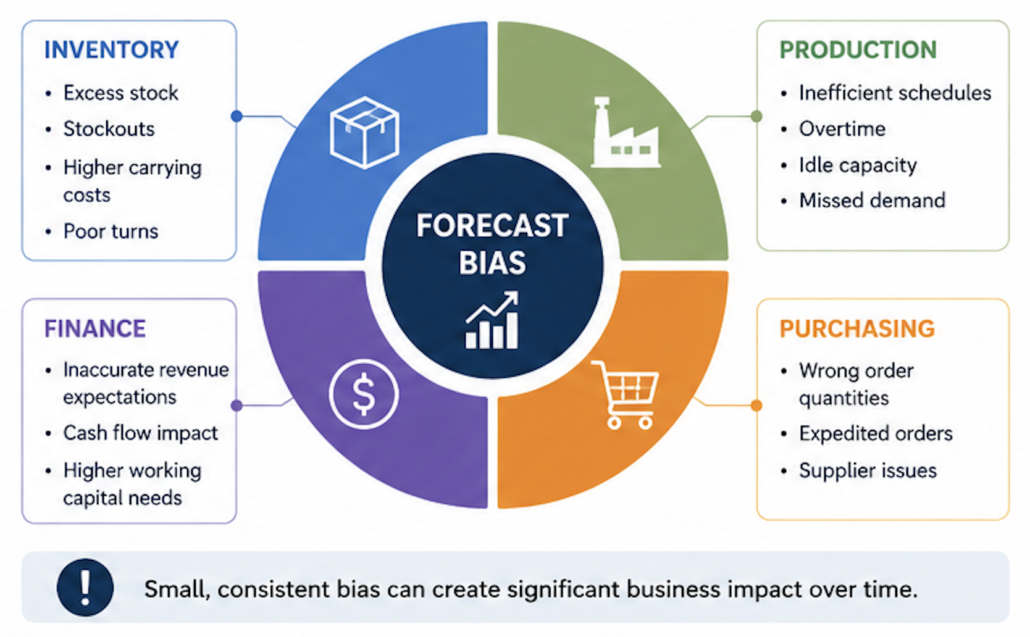
Because demand is consistently overforecasted, purchasing teams continue buying inventory based on inflated demand expectations. Inventory gradually accumulates across warehouses, inventory turns decline, and working capital becomes increasingly tied up in products that are moving more slowly than expected.
The organization may experience:
- excess inventory
- increased carrying costs
- reduced inventory turns
- higher working capital requirements
- increased obsolescence risk
Importantly, these problems can occur even when forecast accuracy appears relatively stable.
The forecasting process is not simply inaccurate.
It is consistently wrong in the same direction.
By identifying and correcting that bias, the organization may improve inventory performance, free up working capital, and improve planning decisions without making dramatic changes to the overall forecasting process.
This example illustrates why forecast bias deserves its own measurement and management process rather than being treated as a subset of forecast accuracy.
Frequently Asked Questions
What is forecast bias?
Forecast bias is the tendency for forecasts to consistently overestimate or underestimate actual demand over time.
Unlike random forecasting errors, forecast bias is directional. A forecasting process that repeatedly produces forecasts that are too high exhibits upward bias, while a process that consistently forecasts too low exhibits downward bias.
Forecast bias is important because it can influence inventory investment, service levels, purchasing decisions, production planning, and financial performance. Even relatively small biases can create significant business impacts when they persist across many products or planning periods.
Is forecast bias the same as forecast accuracy?
No.
Forecast accuracy and forecast bias measure different aspects of forecasting performance.
Forecast accuracy measures the size of forecast errors and helps answer questions such as:
- How close are forecasts to actual demand?
- How large are forecast errors?
Forecast bias measures whether forecast errors consistently lean in one direction and helps answer questions such as:
- Are we consistently overforecasting?
- Are we consistently underforecasting?
Because they measure different things, organizations should monitor both metrics rather than relying on forecast accuracy alone.
Can a forecast be accurate but still biased?
Yes.
This is one of the most common misconceptions in forecasting.
A forecast can appear reasonably accurate overall while still consistently overforecasting or underforecasting demand. For example, a forecasting process that regularly overestimates demand by a similar amount may maintain acceptable forecast accuracy metrics while still introducing significant bias into inventory and purchasing decisions.
This is why forecast bias should be measured separately from forecast accuracy. Monitoring both metrics provides a more complete understanding of forecasting performance.
Why is forecast bias important?
Forecast bias can directly affect inventory performance, purchasing decisions, production planning, customer service, and financial results.
Persistent overforecasting often leads to excess inventory, increased carrying costs, lower inventory turns, and higher working capital requirements.
Persistent underforecasting can result in stockouts, lost sales, expedited freight costs, reduced service levels, and customer dissatisfaction.
Because forecasting drives so many operational and financial decisions, reducing forecast bias can often create meaningful business improvements even when overall forecast accuracy remains relatively unchanged.
How can organizations reduce forecast bias?
Reducing forecast bias typically requires a combination of process discipline, performance measurement, and cross-functional collaboration.
Common best practices include:
- tracking forecast bias separately from forecast accuracy
- reviewing forecast overrides regularly
- improving data quality
- using statistical forecasting as a baseline
- involving multiple departments in forecasting decisions
- monitoring bias trends over time
Organizations that actively measure and manage forecast bias are often better positioned to improve inventory performance, reduce planning risk, and make more balanced business decisions.
What causes forecast bias?
Forecast bias can originate from both human behavior and data-related issues.
Common causes include:
- sales optimism
- executive pressure
- inventory reduction initiatives
- poor data quality
- product lifecycle changes
- repeated forecast overrides
In many organizations, forecast bias develops gradually over time and may go unnoticed unless it is measured explicitly. Regular monitoring helps identify these patterns before they create significant operational or financial consequences.
Final Thoughts
Forecast accuracy tells you how wrong your forecasts are.
Forecast bias tells you whether they are wrong in a consistent direction.
Organizations that monitor both metrics are often better positioned to improve inventory performance, reduce planning risk, and make more informed business decisions.
For manufacturers, distributors, and retailers, reducing forecast bias is often one of the fastest ways to improve planning outcomes without making major process changes.