Stage 1: Reactive Planning
Organizations at the Reactive Planning stage spend most of their time responding to problems rather than proactively managing demand. Planning activities are heavily dependent on spreadsheets, tribal knowledge, and manual intervention. Forecasts may exist, but they are often inconsistent, difficult to maintain, and rarely measured for effectiveness.
Planning teams frequently find themselves reacting to stockouts, inventory imbalances, supplier disruptions, and urgent requests from customers or internal stakeholders. Because there is limited process discipline, outcomes can vary significantly depending on the experience and availability of individual planners.
Characteristics
- Heavy spreadsheet reliance
- Manual planning processes
- Limited forecasting discipline
- Frequent firefighting
- Planning driven by urgent issues
Typical Outcomes
- High inventory variability
- Frequent stockouts
- Excess inventory
- Inconsistent planning performance
Common Statement
“We spend most of our time reacting.”
Stage 2: Structured Planning
Organizations at the Structured Planning stage have begun implementing repeatable planning processes. Forecasting activities occur on a defined schedule, responsibilities are assigned, and planning activities become more organized. While spreadsheets may still play a significant role, there is greater consistency in how planning decisions are made.
The organization begins moving away from reactive behavior and toward a more disciplined planning environment. However, planning success may still depend heavily on the experience of individual team members rather than a fully integrated process.
Characteristics
- Basic forecasting processes
- Standard planning calendars
- Defined responsibilities
- Some planning KPIs
- Improved process consistency
Typical Outcomes
- Improved visibility
- Better planning consistency
- Reduced operational surprises
- More predictable planning cycles
Common Statement
“We have a process, but it still depends heavily on individuals.”
Stage 3: Integrated Planning
Organizations at the Integrated Planning stage recognize that demand planning is not a single-department activity. Sales, operations, supply chain, purchasing, and finance begin collaborating around a shared planning process. Forecasts are reviewed regularly, performance is measured, and planning decisions become more aligned across the business.
This stage often marks a significant shift in planning effectiveness because departments begin operating from a common understanding of demand expectations rather than separate assumptions and priorities.
Characteristics
- Cross-functional collaboration
- Formal planning reviews
- Forecast accuracy measurement
- Demand and supply alignment
- Shared planning objectives
Typical Outcomes
- Improved service levels
- Better inventory performance
- Stronger decision-making
- Increased organizational alignment
Common Statement
“Sales, operations, and supply chain are working from the same plan.”
Stage 4: Data-Driven Planning
Organizations at the Data-Driven Planning stage increasingly rely on analytics to guide planning decisions. Forecast accuracy and forecast bias are actively measured and monitored. Statistical forecasting methods, scenario analysis, and advanced reporting provide planners with deeper visibility into demand patterns and business risks.
Planning decisions become less dependent on intuition and more dependent on measurable performance indicators. Organizations at this stage often achieve meaningful improvements in forecast quality, inventory management, and responsiveness to changing market conditions.
Characteristics
- Statistical forecasting
- Advanced analytics
- Forecast bias monitoring
- Scenario analysis
- Data-driven decision-making
Typical Outcomes
- Higher forecast accuracy
- Reduced inventory investment
- Improved responsiveness
- Better planning confidence
Common Statement
“Data drives planning decisions.”
Stage 5: Continuous Optimization
Organizations at the Continuous Optimization stage view planning as a strategic capability rather than an operational process. Planning performance is continuously monitored, workflows are increasingly automated, and planners focus primarily on exceptions, opportunities, and strategic decisions.
Cross-functional collaboration is deeply embedded within the organization, and continuous improvement becomes part of the company culture. Rather than simply generating forecasts, planning teams actively optimize business outcomes across inventory, service levels, profitability, and growth initiatives.
Characteristics
- Continuous improvement culture
- Automated planning workflows
- Exception-based management
- Enterprise-wide visibility
Typical Outcomes
- Highly efficient planning operations
- Continuous performance improvement
- Strategic decision support
Common Statement
“Our planners focus on exceptions rather than routine tasks.”
Why Planning Maturity Matters
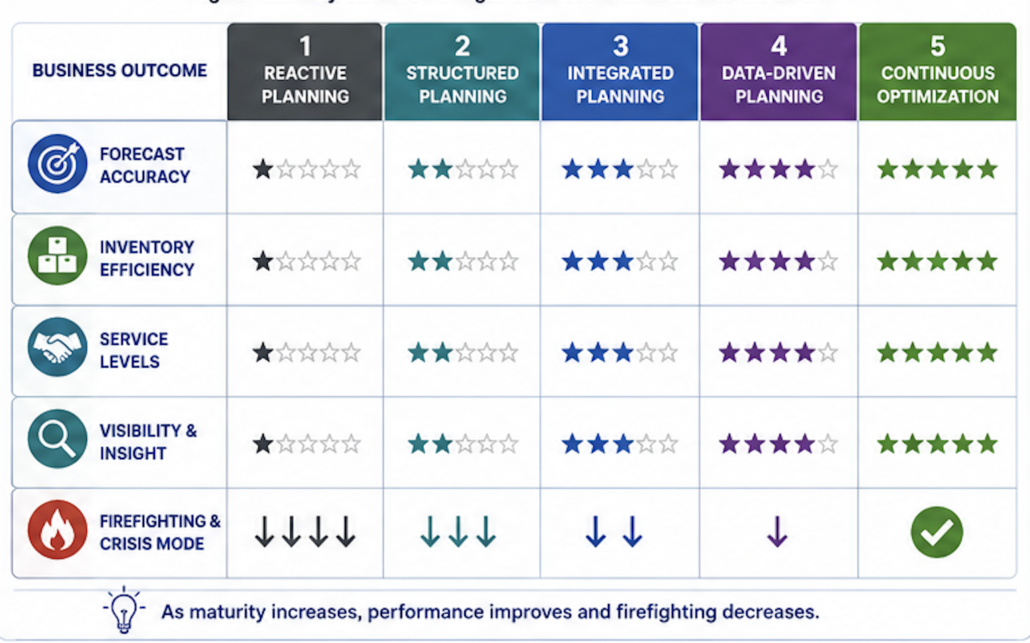
Planning maturity affects far more than forecast accuracy.
As organizations progress through the maturity model, they typically improve the quality, consistency, and speed of planning decisions across the business. Better planning processes help teams anticipate demand changes earlier, align inventory more effectively, collaborate across departments, and respond more quickly to changing market conditions.
Organizations operating at lower maturity levels often spend significant time reacting to issues after they occur. Stockouts, excess inventory, last-minute purchasing decisions, and constant planning overrides can consume valuable time and resources. As maturity increases, planning becomes more proactive and data-driven, allowing teams to focus on preventing problems rather than continuously solving them.
Higher levels of planning maturity are often associated with:
- improved forecast accuracy
- reduced inventory investment
- higher service levels
- better cross-functional alignment
- stronger financial performance
- improved decision-making
The benefits extend far beyond forecasting. Planning maturity influences purchasing, inventory management, operations, customer service, and executive decision-making.
Organizations that continuously improve planning maturity often create a competitive advantage by making better decisions faster and with greater confidence.
How to Assess Your Current Maturity
Many organizations struggle to accurately assess their planning maturity.
Some underestimate their capabilities because they focus only on their challenges. Others overestimate maturity because certain planning activities exist, even if they are not consistently followed or measured.
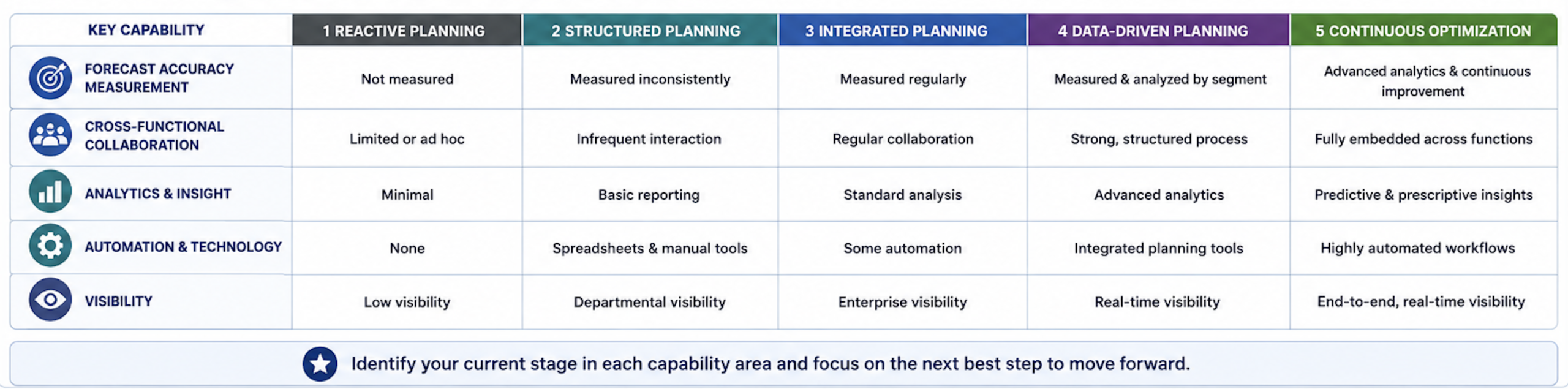
A useful maturity assessment evaluates not only the tools being used, but also the processes, collaboration, performance measurement, and decision-making practices that support planning.
Consider questions such as:
- Do we formally measure forecast accuracy?
- Do we monitor forecast bias and forecasting performance trends?
- Are planning decisions collaborative across departments?
- How dependent are we on spreadsheets and manual processes?
- Do planners spend more time analyzing future demand or reacting to problems?
- Are planning reviews structured and recurring?
- Can we quickly evaluate multiple planning scenarios?
- Is inventory performance consistently improving over time?
The answers can provide valuable insight into current planning maturity and help identify the most impactful opportunities for improvement.
The objective is not to achieve a perfect score. The objective is to understand your current state and identify the next logical step in your planning journey.
Signs You’ve Outgrown Your Current Planning Process
Planning requirements evolve as organizations grow.
Processes that worked effectively when managing a smaller product portfolio or customer base may become increasingly difficult to maintain as complexity increases. Many organizations do not realize they have outgrown their planning process until operational challenges begin affecting inventory performance, service levels, or profitability.
Common indicators include:
Increasing SKU Counts
As product portfolios expand, forecasting complexity grows significantly. More products create more demand patterns, more replenishment decisions, and more opportunities for forecasting errors. Planning processes that worked with hundreds of SKUs often become difficult to sustain when managing thousands.
Growing Inventory Investment
If inventory levels continue rising faster than sales growth, it may indicate that planning processes are struggling to keep pace with business complexity. Excess inventory is often a symptom of uncertainty rather than a deliberate strategy.
Declining Service Levels
Increasing stockouts, missed shipments, and declining customer service performance may indicate weaknesses in forecasting, inventory planning, or replenishment processes. As planning complexity grows, these issues often become more visible.
Spreadsheet Complexity
Many organizations reach a point where spreadsheets become difficult to maintain, audit, and scale. Multiple versions, manual updates, and disconnected planning files can create significant inefficiencies and increase planning risk.
Frequent Planning Overrides
When planners routinely override forecasts, expedite purchases, or make last-minute adjustments, it often indicates that current planning processes are struggling to support business requirements. Excessive firefighting is frequently a sign that maturity improvements are needed.
How to Improve Demand Planning Maturity
Improving planning maturity is rarely about making a single dramatic change. Most organizations progress by strengthening processes, improving measurement, increasing collaboration, and gradually introducing better tools and capabilities.
Process First
Technology can support planning excellence, but it cannot replace a weak planning process. Organizations should first establish consistent forecasting, inventory planning, and review processes before focusing on advanced capabilities. Strong processes create the foundation for long-term improvement.
Measure Performance
Improvement requires visibility. Organizations should consistently track metrics such as forecast accuracy, forecast bias, service levels, inventory turns, and inventory investment. Measurement helps teams identify opportunities, monitor progress, and make more informed planning decisions.
Improve Collaboration
Demand planning is not a supply chain activity alone. Sales, operations, finance, purchasing, and inventory management all influence planning outcomes. Organizations that improve collaboration often achieve stronger forecasting performance and better business alignment.
Leverage Better Tools
As planning complexity increases, spreadsheets often become increasingly difficult to manage effectively. Purpose-built planning tools can help organizations improve visibility, automate routine activities, support scenario analysis, and create more scalable planning processes. Technology should support maturity improvements rather than drive them.
Frequently Asked Questions
What is a demand planning maturity model?
A demand planning maturity model is a framework used to evaluate how effectively an organization forecasts demand, plans inventory, collaborates across departments, and uses technology to support decision-making. Maturity models help organizations identify strengths, uncover improvement opportunities, and create a roadmap for achieving better planning outcomes over time.
What is the highest level of planning maturity?
The highest level is Continuous Optimization. Organizations operating at this stage typically use advanced planning processes, strong cross-functional collaboration, automated workflows, performance measurement, and continuous improvement practices. Rather than reacting to issues, they focus on proactively optimizing planning performance and supporting strategic decision-making.
Why is planning maturity important?
Planning maturity directly influences business performance. Organizations with higher maturity levels often achieve stronger forecast accuracy, lower inventory investment, improved service levels, better collaboration, and more effective decision-making. Improving maturity helps organizations operate more efficiently while reducing planning-related risk.
Can small companies use a maturity model?
Yes. Planning maturity models are valuable for organizations of all sizes. Smaller companies can use the framework to identify current capabilities and establish improvement priorities, while larger organizations can use maturity assessments to support more advanced planning initiatives. The principles remain relevant regardless of company size.
Does demand planning software improve maturity?
Demand planning software can support maturity improvements by providing better visibility, automation, analytics, and collaboration capabilities. However, technology alone does not create planning excellence. Process discipline, performance measurement, organizational alignment, and continuous improvement are equally important components of maturity growth.
Final Thoughts
The most successful planning organizations do not become highly mature overnight.
They improve incrementally.
Each stage of the demand planning maturity model represents a meaningful step toward better forecasting, stronger inventory performance, improved collaboration, and more informed decision-making. Organizations that consistently strengthen planning processes often achieve significant benefits long before reaching the highest levels of maturity.
The objective is not to become a Stage 5 organization as quickly as possible. The objective is to identify your current capabilities, understand your most important planning challenges, and focus on the next improvement that will create measurable business value.
Whether your organization is currently operating with spreadsheets and manual processes or using advanced analytics and automation, there is always an opportunity to improve planning performance.
The companies that achieve the best long-term results are typically not those with the most sophisticated technology. They are the organizations that continuously improve their processes, measure performance, strengthen collaboration, and make planning a strategic business capability.
Planning maturity is not a destination.
It is an ongoing journey toward better business outcomes.

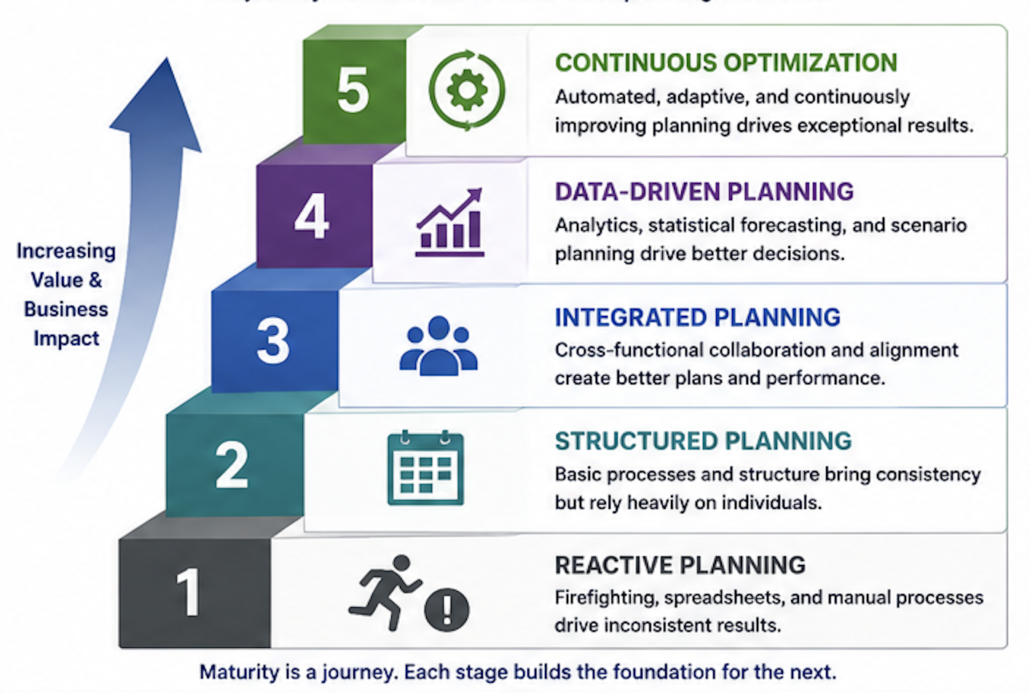 Organizations typically progress through five stages as planning capabilities mature. While every company is different, most planning organizations exhibit characteristics that align closely with one of these stages.


